|
| The Garden at the L'Espirit du Chemin |
In 2006 we began our Camino
in St. Jean Pied du Port, France.
in St. Jean Pied du Port, France.
From the USA we flew into Amsterdam
and stayed a few days.
and stayed a few days.
Then we took a train to Paris for another few days' stay.
Then another train to Bayonne
where we arrived too late to make the connection
to St. Jean Pied du Port (SJPP).

Finding lodging in Bayonne wasn't difficult
and next morning we headed to the train station
and caught our train to SJPP.
If you look closely,
you'll see the fare was €16.

We had made reservations at Albergue L'Espirit du Chemin.
This is a very popular albergue,
and for a good reason.
It is clean, on the main street, the food is excellent,
and the staff is very helpful.
 |
| The rooms are nice! |
 |
| From our Albergue window |
We checked in, then spent the day
going to the Pilgrim Office to get our Credential stamped
and buying small things we needed
- a knife, some fels naptha for laundry.
 |
| Joe did some laundry. |
well worth the price!
 |
| A well-dressed pilgrim in ancient times |
 |
| And what his companion wore |
The medieval costumes were interesting to me.
What does a modern pilgrim WEAR while they walk?
The costume has not changed much over the centuries!
What does a modern pilgrim WEAR while they walk?
The costume has not changed much over the centuries!
These are photos taken at the Pilgrim Museum. You can see that the primary item of medieval pilgrim couture is THE HAT. Every pilgrim needs a hat to protect them from sun, wind, and rain. A hat with a wide brim will provide shade, as well as protect the back of the neck. A crushable/packable hat can be put away on those days you choose to walk bare-headed.
Under the hat, the medieval pilgrim wore a scarf. The scarf protected the neck from the elements and in the case of the female pilgrim, doubled as a shawl. It provided some shade. For modern pilgrims, this might be a tight-fitting lightweight microfiber or wool hat that can be worn under the brimmed hat, or it might actually be a scarf or kerchief. In hot weather, a kerchief is a great thing, dipped in water, to keep the pilgrim cool while walking. At night, the hat can be wrapped up in the scarf and voila! You have a pillow!
The medieval pilgrim's clothing was layered. This is still a smart way to dress for the modern pilgrim. Layering your clothes makes it possible to walk through all temperatures comfortably. The weather on the Camino can change from moment to moment. Mornings can be very chilly while afternoons can be very hot. Peeling off layers is easier than stopping to completely redress yourself! On cold days instead of a heavy jacket, a modern pilgrim might wear long underwear covered by a longsleeved fleece, covered by a loose shortsleeved shirt, covered by a lightweight Goretex jacket or poncho.
The male pilgrim wore a cape.
It could be used to make shade, to keep one dry during rain,
warm during chilly weather,
and was the medieval version of a sleeping bag at night.
My ALTUS poncho serves a similar purpose.
Lightweight cotton long sleeves protected one from the burning sun, and is still an excellent idea! I have a white gauze shirt that I put on to protect me from sunburn. It is lighter to carry and much safer for my allergies than chemical sunscreen.
Medieval pilgrims carried a staff. Today, many pilgrims still walk with a staff they purchase from local artisans along the way, or they use trekking poles. These poles are good for keeping your balance while fording streams, walking in slippery mud, climbing hills, and discouraging pesky dogs
(or people).
(or people).
The medieval pilgrim also carried a bag over their shoulder where they kept various needful things. Modern pilgrims wear a waistpack and money belt for the same reason.
Water must be carried. Medieval pilgrims carried their water in a gourd. Today, we use camelback systems or bottles, and fresh fountains of water can found in nearly every village along the way.
So as you see,
not so much has changed between then and now.
We still travel light.
We still dress appropriately.
And we still proudly display the Scallop Shell
as we walk under the Milky Way toward our goal,
Santiago de Compostela.
They Call it Hell Day
They Call it Hell Day
We had originally made reservations
for our second night at Orisson,
8 kilometers up the road.
We had heard the first day's trek to Roncevalles
was called "Hell Day."
was called "Hell Day."
Our hospitalero pooh-poohed that idea and said,
"It's EASY!
You can make it to Roncevalles EASY!
Don't stop at Orisson!"
So we called and cancelled our reservations for Orisson.
I would regret that decision for the rest of the trip.
Pilgrim Lesson 1
Listen to your gut instinct!
I would strongly recommend for anyone asking
that you DO stop at either Orisson or Hunto your first night.
If you are in great physical shape,
and are used to walking 15 miles a day,
then go for it.
But otherwise,
you take a risk of ruining your Camino
on Day 1.
If you are in great physical shape,
and are used to walking 15 miles a day,
then go for it.
But otherwise,
you take a risk of ruining your Camino
on Day 1.
Yes, it is true that it is only 8 kilometers up the Way,
but it is 8 kilometers with a 620 meter ascent
and unless you are in prime shape,
the climb can be grueling.
Stopping after 8 kilometers
gives you a good idea of what's ahead.
gives you a good idea of what's ahead.

That 8 kilometer difference the next day
can make the difference
between arriving in good shape or arriving injured,
between arriving in good shape or arriving injured,
which was what happened to me.
I literally cried every step into Roncevalles
the last few kilometers.
the last few kilometers.
I was in so much unbelievable pain.
How would I ever walk another step?
Some "pilgrims" who had been dropped off
at the crest of the mountain
at the crest of the mountain
by a big tour bus
saw me crying and gave me chocolate.
It got me down the mountain, and
I must admit,
it challenged my opinion
that they weren't really pilgrims!
Pilgrim Lesson 2
Each Pilgrim Travels Their Own Way
During the night,
when I needed to get up to use the toilet,
I almost screamed when my feet hit the floor.
My feet took weeks to recover.
It was unnecessary
and caused by trying to do too much on the first day.
Our feet are not used to carrying 15 extra pounds
and walking continuously for 8 hours.
We walk here and there in little spurts,
then sit down,
on a normal day.
That type of walking,
especially up and over the Pyranees,
is hard on the tootsies!
So here it is, my advice.
Take it or leave it.
Listen to your own gut.

STOP your first night in either Hunto or Orisson or
in the new albergue at BORDA.
You will need to make reservations -
then don't let anyone talk you out of it.
If you cannot get reservations at Hunto, Orisson, or Borda
the answer is to book TWO nights in SJPP.
You walk up to Orisson the first day,
and either taxi or walk down.
The second day you taxi up to Orisson,
and continue your walk over the mountain.
If you cannot get reservations at Hunto, Orisson, or Borda
the answer is to book TWO nights in SJPP.
You walk up to Orisson the first day,
and either taxi or walk down.
The second day you taxi up to Orisson,
and continue your walk over the mountain.
Except for their advice,
the hospitaleros at L'Espirit were wonderful folks!
They fed us a lucious dinner,
where we ate family style
and were introduced to the first pilgrims
besides ourselves.
They also packed a nice lunch for us to carry next day
and provided us with breakfast.
I highly recommend L'Espirit du Chemin.
* * * * *
2012
When walking the Camino, it's safer not to have expectations.
Just be open to whatever the Camino brings.
This is sometimes difficult.
We like to be in charge.
However, on The WAY, the Camino is in charge
and you will find yourself much happier
if you let go of the reins and let the Camino guide you.
Just go with the flow, as they say,
and all will be well.
I had some questions this morning
about walking the section from St. Jean Pied de Port
and how our group manages this section if the weather is bad.
We began with a taxi ride from Pamplona.

If you are arriving in SJPP,
the first thing to do is check into your gite,
especially if you are walking in the busy months of June, July, or August.
Once you are settled in,
next stop should be the Pilgrim Office.
The Pilgrim Office is on the main street,
the ONLY main street of the village.
You can't miss it.
You will walk into the office and wait in line.
There will be several volunteers speaking various languages who will be there to help you.
You will pay (3 euros in 2012) and be presented with your Credential, complete with it's first stamp!


You will get this credential stamped
in each village where you stop along the way.
Once you reach Sarria,
you will need 2 stamps per day.
If your credential fills up,
you can get another along the route.
You can also pick up your shell here
for a donation.
I usually leave €2.
2013

* * * * *
2012
When walking the Camino, it's safer not to have expectations.
Just be open to whatever the Camino brings.
This is sometimes difficult.
We like to be in charge.
However, on The WAY, the Camino is in charge
and you will find yourself much happier
if you let go of the reins and let the Camino guide you.
Just go with the flow, as they say,
and all will be well.
I had some questions this morning
about walking the section from St. Jean Pied de Port
and how our group manages this section if the weather is bad.
We began with a taxi ride from Pamplona.

If you are arriving in SJPP,
the first thing to do is check into your gite,
especially if you are walking in the busy months of June, July, or August.
Once you are settled in,
next stop should be the Pilgrim Office.
The Pilgrim Office is on the main street,
the ONLY main street of the village.
You can't miss it.
You will walk into the office and wait in line.
There will be several volunteers speaking various languages who will be there to help you.
 |
| Teresa gets her Credential |
 |
| Pilgrims Getting Credentials |


 |
| Ready for the Camino! |
in each village where you stop along the way.
Once you reach Sarria,
you will need 2 stamps per day.
If your credential fills up,
you can get another along the route.
You can also pick up your shell here
for a donation.
 |
| Galia picks out her shell. After you have your credential, it's a great time to poke around the village. There is a Pilgrim's Museum, which is worth seeing, and several other sites, including the church. There are shops where you can purchase food for the next day if want. There is a sports shop where you can purchase clothing and other hiking gear.The name is Direction Compostelle and it is right across the walkway from the Pilgrim Office.  There are a LOT of opportunities to purchase walking sticks. There are some lovely pastry and coffee/tea shops. There is an incredible spice shop to visit! There is a hardware store where you can buy a knife and a bar of soap for handwashing clothes.Pretty much everything you need for the Camino can be purchased reasonably in this tiny village. * * * * * |

For several years now,
we have stayed in Gite Compostelle in SJPP.
we have stayed in Gite Compostelle in SJPP.
We've been very happy in this sweet little gite,
which is a bit off the main drag in St. Jean.
which is a bit off the main drag in St. Jean.
A short, 5 minute walk, gets you into the main village.
The gite has a kitchen, which is not exactly modern,
but sufficient.
but sufficient.
There is a refrigerator, 4 burner stove,
and plenty of counter space.
and plenty of counter space.
The dining room has lots of table and chair space for hungry pilgrims who want to cook for themselves.
 |
| The rooms are modest but clean. |
If you want a private room,
you must book it.
Otherwise, there are dorms.
you must book it.
Otherwise, there are dorms.
 |
| The friendly kitchen |
The showers are shared, but sufficient.
The water is nice and hot.
There are places for doing hand-wash,
and lines to set up outside, weather permitting.
and lines to set up outside, weather permitting.
The gite rooms are older, but clean.
They do have some private double accommodation.
I know that other albergues in St. Jean might be more convenient, but I love the owners of this place. They are jolly and friendly and do all they can to help make us comfortable.
And that's good customer service!
2014 Spring/Summer
In 2014, we met our group in Pamplona.
From there we took a taxi to SJPP.

SOME HISTORY OF ST. JEAN PIED DE PORT




2014 Spring/Summer
In 2014, we met our group in Pamplona.
From there we took a taxi to SJPP.
 |
| Of course, we had to begin with desayuno |
 |
| Barbara is ready to go! |
 |
| This was a warning of what was to come! |
 |
| Taxnavarra took us from Pamplona to SJPP |
 |
| Our wonderful taxi driver! |
 |
| At the Pilgrim Office in SJPP |

 |
| Barbara has her Credential |
 |
| Looking forward to tomorrow |
SOME HISTORY OF ST. JEAN PIED DE PORT
I had a heck of a time finding much history on St. Jean Pied de Port. Most websites I found referred back to Francis Miltoun’s book, Castles and chateaux of old Navarre and the Basque Provinces, copies of which can be found and read for free online.
SAINT-JEAN-PIED-DE-PORT is the ancient capital of Basse-Navarre and is the gateway to one of the seven passes of the Pyrenees. For me, walking under the arched entrance to the town was like walking through a time-warp into the past. In fact, if you look closely at this old drawing, this older photo and this modern photo, you will see that not a lot has changed over time.


The original town at nearby Saint-Jean-le-Vieux (St. Jean the Old) was razed to the ground in 1177 by the troops of Richard the Lionheart after a siege. The Kings of Navarre re-founded the town on its present site shortly afterwards.
The town was once a part of the Spanish province of Navarre and the Basque language is still spoken on both sides of the border and they still share similar traditions.
The town stands at the base of the Roncevaux Pass through the Pyrenees. Pied-de-Port means 'foot of the pass' . The routes from Paris, Vézelay and Le Puy-en-Velay meet at Saint-Jean-Pied-de-Port and this was and remains the pilgrims' last stop before the arduous mountain crossing.


In 1998, the Porte St-Jacques (city gate) was added to the UNESCO World Heritage Sites as one of the sites along the Routes of Santiago de Compostela in France. This walled and bastioned capital was one of the keys of France in feudal times. The old walls and its great medieval arched are the subject of almost every pilgrim’s photo journal.
Along the river bank the houses sit right on the water with no shore line at all. It reminds one of Venice in that respect.

The streets are cobbled, and most of the shutters and doors are painted brown or red. Miltoun mentions milk jugs hanging everywhere, with copper bands, ornaments of the royal crown, the fleur-de-lis, the initial H and the following inscription: "à le grand homme des pays béarnais et basques." (To the great man of the country of the Bernais and Basques). People seem to have lost track of what these jugs mean.
The houses are rectangular, with roofing in 2 sections of tiles.
Walls were whitewashed in lime. Door, window and corners were covered in pink sandstone. Lintels are sculpted in stone with inscriptions mentioning the names of the owners. A date is often added, and can be the date of building or often that of the renovation of the home. They also have symbols: solar, religious, and ancient construction tools.
Walls were whitewashed in lime. Door, window and corners were covered in pink sandstone. Lintels are sculpted in stone with inscriptions mentioning the names of the owners. A date is often added, and can be the date of building or often that of the renovation of the home. They also have symbols: solar, religious, and ancient construction tools.

In 1523 the great tower and fortifications of Saint-Jean-Pied-de-Port were razed by order of the king of Navarre. The decree, dated and signed from "notre château de Pau," read in part thus: —
"Know you that the demolition of the walls of the city of Saint-Jean-Pied-de-Port is not made for any case of crime or felony or suspicion against the inhabitants ... and that we consider said inhabitants still as good, faithful vassals and loyal subjects."
Also from Francis Miltoun’s book Castles and Chateaux of old Navarre and the Basque Provinces:
The existing monuments of Saint-Jean-Pied-de-Port are many, though no royal residences are left to remind one of the days when kings and queens tarried within its walls. Instead one must be content with the knowledge that the city grew up from a Roman bourg which in the ninth century was replaced with the predecessor of the later capital. Its name, even in this early day, was Saint-Jean-le-Vieux, and it was not until the eleventh or twelfth centuries that the present city took form, founded doubtless by the Garcias, who were then kings of all Navarre. Saint-Jean belonged to Spain, as did all the province on the northern slope of the Pyrenees, until the treaty of 1659, and the capital of the kingdom was Pamplona.
Under the three reigns preceding the French Revolution the city was the capital of French Navarre, but the French kings, some time before, as we have seen, deserted it for more sumptuous and roomy quarters at Pau, which became the capital of Béarn and Navarre.
The chief architectural characteristics, an entrancing mélange of French and Spanish, are the remaining ramparts and their ogive-arched gates, the Vieux Pont and its fortified gateway, and the fifteenth and sixteenth century church. The local fête (August fifteenth-eighteenth) is typical of the life of the Basques of the region, and reminiscent, in its "charades," "bals champêtres," "parties de pelote," "mascarades," and "danses allegoriques" of the traditions of the past.
Saint-Jean-Pied-de-Port lies in the valley of the Nive, and St. Étienne-de-Baigorry, just over the crest of the mountains, fifteen kilometres away, in the Val de Baigorry, is the chief town of a commune more largely peopled than that presided over by Saint-Jean-Pied-de-Port. Really the town is but a succession of hamlets or quarters, but it is interesting because of its church, with its great nave reserved exclusively for women, even to-day — as was the ancient Basque custom — and the Château d'Echaux sitting above the town.
The château was the property of the ancient Vicomtes of Baigorry, and is a genuine mediæval structure, with massive flanking towers and a surrounding park.
One of the Vicomtes de Baigorry, Bertrand d'Echaux, was also bishop of Bayonne, and afterwards almoner to Louis XIII. That monarch proposed to Pope Urban VIII to make his almoner a cardinal, but death overtook him first.
The nephew of this Bertrand d'Echaux, Jean d'Olce, was also a bishop of Bayonne, and it was to him, in the church of St. Jean de Luz, fell the honour of giving the nuptial benediction to Louis XIV and the Infanta Marie-Thérèse upon their marriage.
The Château de Baigorry of the Echaux belonged later to the Comte Harispe, one of the architects of the military glory of France. He first engaged in warfare as a simple volunteer, but died senateur, comte, and maréchal of France.
There is a first class legend connected with the daughter of the chatelain of D'Echaux. A certain warrior, baron of the neighbouring château of Lasse, became enamoured of the daughter of the Seigneur d'Echaux, Vicomte de Baigorry, and in spite of the reputation of the suitor of being cruel and ungallant the vicomte would not willingly refuse the hand of his daughter to so valiant a warrior, so the young girl — though it was against her own wish — became la Baronne de Lasse.
The marriage bell echoed true for a comparatively long period; it was said that the soft character of the lady had tempered the despotism of her husband. One day a young follower of Thibaut, Comte de Champagne, returning from Pamplona in Spain, knocked at the door of the Château de Lasse and demanded hospitality, as was his chevalier's right. The young knight and Madame la Baronne fell in love at first sight, but not without exciting the suspicions of the baron, who, by a subterfuge, caught the loving pair in their guilt. He threw himself upon the young gallant, pierced his heart with a dagger-thrust, cut him into pieces, and threw them into the moat outside the castle walls.
An improvised court of justice was held in the great hall of the castle, and the vassals, fearing the wrath of their overlord, condemned the unhappy woman to death, by being interred in a dungeon cave and allowed to starve.
When the Vicomte de Baigorry heard of this, he marched forthwith against his hard-hearted son-in-law, and after a long siege took the château. Just previously the baron committed suicide, anticipating the death that would have awaited him. This is tragedy as played in medieval times.
Between Saint-Jean-Pied-de-Port and Saint-Etienne-de-Baigorry, just by the side of the road, is the ruined château of Farges, a famous establishment in the days of the first Napoleon's empire, though a hot-bed of political intrigue. Its architectural charms are not many or great, the garden is neglected, and the gates are off their hinges. The whole resembles those Scotch manors now crumbling into ruin, of which Sir Walter has given so many descriptions. At Ascarat, too, is a house bearing a sculpture of a cross, a mitre, and two mallets interlaced on its façade, with the date 1292. It is locally called "La Maison Ancienne," but the present occupant has given it frequent coats of whitewash and repaired things here and there until it looks like quite a modern structure.
Above Saint-Jean-Pied-de-Port, on the road to Arnéguy, is the little hamlet of Lasse, with a church edifice of no account, but with a ruined château donjon that possesses a historic, legendary past. It recalls the name of the baron who had that little affair with the daughter of the Vicomte de Baigorry.
The cobbled rue de la Citadelle runs downhill and over the river from the fifteenth century Porte St-Jacques to the Porte d'Espagne by the bridge.
From the bridge, there are views of the old houses with balconies overlooking the Nive.


Notice in the older black and white photo there is a steeple (or is it a chimney?) on the top of the church clock tower. I wonder what happened to it?
Many of the buildings are very old, of pink and grey schist, and retain distinctive features, including inscriptions over their doors. One, a bakery, lists the price of wheat in 1789.
The 14th century red schist Gothic church,
Notre-Dame-du-Bout-du-Pont, stands by the Porte d'Espagne.
The original was built by Sancho the Strong of Navarre
to commemorate the 1212 Battle of Las Navas de Tolosa
where Moorish dominance of Spain was undermined.

Walking through town, you can see the clock tower to the right of the church:

Above the town at the top of the hill is the citadel, remodeled by Vauban in the 17th century. This is worth a short walk to see.

The village is now an important tourist center for the Pyrenees and the French Basque country and there are shops, restaurants and hotels. Traditional crafts and foods remain for sale in the village,
including Basque linen from the Inchauspé family since 1848.
The Basque cuisine is one of the finest cuisines around.
St Jean Pied de Port specialize in fromage de brebis
or OssauIraty; a sheeps cheese.


There is also local trout, often served "a la plancha."

Another tasty dish is called pipérade.
It is an sort of omelette with peppers and Bayonne ham.

Sometimes there is more sauce than egg,
but it is still very good eating!

Mondays there is a large street market,
with opportunity for fresh produce.
with opportunity for fresh produce.

Sheep and cattle are also driven into the town on market day.

At 5pm, there is a communal game of bare-handed pelote at the fronton. Basque pelota is the name for a variety of court sports played with a ball using one's hand, a racket, a wooden bat or a basket, against a wall (frontón in Spanish, pilotaleku or pilota plaza in Basque, frontó in Catalan, fronton in French)
or, more traditionally, with two teams face to face separated by a line on the ground or a net. The game roots can be traced to the Greek and other ancient cultures.
The Basque term pilota comes from the Latin "pilum" (javelin)
via Provençal "pilota" (ball).
Today, Basque pelota is played in several countries.
In Europe, this sport is concentrated in Spain and France,
especially in the Basque Country and its neighboring areas.
The sport is also played in Latin American countries
such as Argentina, Chile, Cuba, Mexico, Perú and Uruguay.
Operated as a gaming enterprise called Jai Alai,
it is seen in parts of the U.S. such as Florida, Connecticut,
Nevada, and Rhode Island.


There are large fairs in SJPP four times a year.
At these fairs, you can see beautiful Basque folk costumes and dance.


While in St. Jean Pied de Port, there are many interesting things to see.
First are the four medieval gates to the town.
There is Porte de France.

Porte de Navarre, which was once called Porte du Marche.

There is Port St. Jacques.

After you arrive and check in to your albergue,
stop at the Pilgrim Office (Accueil pélerins) at No. 39
and pick up your Credencial.

Keep this handy, because you will stop at places along the Camino
to have your Credential stamped.
You will get your first stamps in SJPP.
Each stamp is unique, and tells the story of that particular place.
The Credential (Créancial in French and Credencial in Spanish)
usually costs between 1 and 3 Euros.
It is a wonderful record of your trip,
and many people frame theirs upon return home.

While at the Pilgrim Office, you can check on current weather conditions and any updates the authorities might have for you.
From there, walk to The Bishop's Prison (Le Maison des Eveques) is a great place to visit while in SJPP. This interesting vaulted cellar area on the Rue de la Citadelle has a long and confusing history. Why it has the name it does, no one is completely sure. Although in the 13th Century this area was controlled by the Bishop of Avignon, the building was not known to have been used as a prison until many hundreds of years later when the bishop had left the area. It has also been used as a town jail, a military storage center and an internment camp for prisoners of war in the Second World War. This museum displays many interesting artifacts from the Camino including costumes worn in older times and Templar gear.

The Citadelle is a short walk from town.
From here, there are some fine views of the town
and they Pyrenees you will be climbing the next day.
This citadelle was remodeled in the 17th century.
Sébastien Le Prestre, Seigneur de Vauban
and later Marquis de Vauban (15 May 1633 – 30 March 1707),
commonly referred to as Vauban, was a Marshal of France
and the foremost military engineer of his age,
famed for his skill in both designing fortifications and breaking through them.
A citadel is a fortress for protecting a town, sometimes incorporating a castle.The term derives from the same Latin root as the word "city", civis, meaning citizen.
In a fortification with bastions, the citadel is the strongest part of the system, sometimes well inside the outer walls and bastions,
but often forming part of the outer wall for the sake of economy.
It is positioned to be the last line of defence
should the enemy breach the other components of the fortification system.

St. John Pied de Port (SJPP) has a pharmacy where you can stock up on Compeed and bug spray and a hardware store where you can find good bar laundry soap. You may also want to buy some cheese, bread, and fruit for your walk the next day.
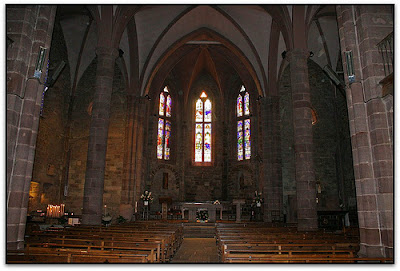
The night before you walk, it might be nice to check in at the church of Our Lady (Notre Dame du Bout du Pont) to see if there will be a Pilgrim's Mass held. The Pilgrim's Blessing is a special way to begin your Camino, even if you are not Catholic.

The last gateway you will see Port D'Espagne,
which you will walk through on your way to Roncesvalles.
Don't forget to fill your water bottles with cold mountain water
at the fountain on the way out of town.

This should give you a good idea of where we will begin.
Have fun planning and dreaming and
Buen Camino!
Annie