CHURCHES:
The Cathedral of Santa María is the city’s most emblematic monuments and the one which has the greatest number of historical and artistic treasures.
Iglesia de San Nicolás, the church-fortress of San Nicolás (XII century) was the main religious building in the burgh of San Nicolás. Its main purpose was to defend the burgh from its neighbours and, to this end, it was equipped with thick walls, wrought-iron railings and three watchtowers, of which only one, restored in 1924, remains.
Iglesia de San Cernin o San Saturnino was built in the 13th century by the kings of Navarra. (in that period they were French hence the French names).
This was also a fortified church. It has an interesting Baroque chapel dedicated to the Virgen del Camino (13th century)
Iglesia de San Lorenzo (Calle Mayor, 74). Built in 1901, by Florencio Ansoleaga, upon the remains of a Baroque church, this building is Neoclassic in style. Inside you can visit the San Fermín chapel,which is very important during the fiestas in Pamplona which carry the same name.
MUSEUMS:
Museo de Navarra: (Cuesta de Sto. Domingo, s/n) A wonderful art and history museum.
Capilla Museo: A religious art museum (Renaissance and Baroque)
Municipal Archive and the former San Juan Seminary: (c/ Mercado, 11).
Museo Pablo Sarasate: Tells the story of Pamplona's musical history since 1983.
Museo Diocesano: 14th century. It holds sacred objects such as sculptures, pictures and gold and silver objects from Navarra.
IMPORTANT BUILDINGS:
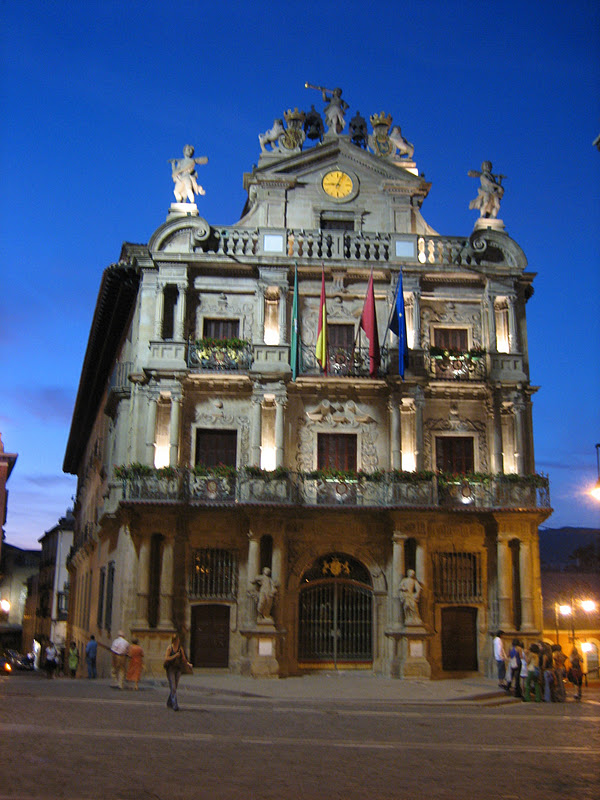
The Town Hall: This emblematic Baroque building dates back to 1752, built by José Zay and Lorda. The San Fermines fiestas begin here with the famous 'chupinazo' (loud firework) which is set off here.
Palacio de Navarra or Diputación (government buildings): Neoclassic dating back to the middle of the 19th century. Built by José de Naguria. It is now the headquarters for the Navarran government. It also has a painting of Fernando VII by Goya.
Cámara de Comptos:
This is a 13th century medieval palace which between 1525 and 1836 was used as an auditor's office for the Navarran kingdom. It houses a collection of Navarran coins covering all periods.
Palacio de los Navarros Tafalla: (c/ Zapatería, 50). Baroque, 18th century. During the 20th century it was used as the Law Courts. Now it is used by the Navarran parliament.
Palacio Real and Archivo General de Navarra: (c/ Dos de Mayo).It dates back to 1190. During the middle ages it was used as a residence by kings and bishops(Carlos II, Felipe III, José Bonaparte).
SCULPTURE
Polyphemus. José Ramón Anda 1993
Park of Antoniutti
Cypress woman. Alfredo Sada 1990
Vuelta del Castillo
The Mari Blanca. Luis San Martín 1790
Park of La Taconera
Kings of Navarre
Paseo Sarasate
Monument to the Fueros. Manuel Martínez de Ubago, 1903. Paseo Sarasate
Carlos III, next to the Plaza del Castillo
Bronze sculpture of the King of Navarre,
Monument to Ernest Hemingway. Luis Sanguino, 1968. Beside the Bullring
Monument to the Bull Run. Rafael Huerta, 1994
Calle Roncesvalles, near to the Bullring
Sancho III the Great. Alberto Orella, 2004
Park of la Media Luna
PARKS
Gardens of La Tocanera. The Park of La Taconera, created in around 1830, is the city’s oldest and most beautiful park. You can enter La Taconera from different points and at any time because it is not a enclosed park and is open night and day. The most elegant entrance is the Gateway of San Nicolás, in Calle del Bosquecillo. A Baroque gateway based on an Arc de Triomphe, it used to be one of the six entrances to the walled city and was located, until 1915, near to the Church of San Ignacio. Only its façade remains. The remains of the old Gateway of La Taconera, demolished at the same time, are next to the track in the Park of Antoniutti. Hidden in amongst the trees, visitors to La Taconera can discover the figure of the Mari Blanca. The figure was designed by Luis Paret to crown a fountain in the Plaza del Castillo. It dates from the end of the XVIII century and is one of the city’s most popular images. One side of the gardens is taken up by moats, which house a small zoo enclosure with deer, ducks, rabbits and peacocks. The railings which open out onto Calle Navas de Tolosa are a favourite among the city"s children. The most important monument on the central pathway in the gardens of La Taconera is of Julián Gayarre, erected in 1950 by Fructuoso Orduna and Víctor Eusa in honour of the famous tenor from the Valley of Roncal. The figure of Gayarre crowns a cylinder sculpted with bas-relieves around a fountain.
FESTIVALS:
Feb 3: San Blas. 3rd of February:
The image of the saint is venerated in the Church of San Nicolás, where the faithful flock to have food blessed. On the day of the festival, the porches around the church are full of stalls
selling pastries and sweets which have been blessed.
Feb 4 · Santa Águeda. On this day, young people pass through the streets of the city singing popular songs in Basque about the life of Santa Águeda, while marking the rhythm with their sticks (makilas) on the ground.
July 6 - San Fermin: The Running of the Bulls. See this link from the Council of Pamplona for all the information on the San Fermin Festival.
Holy Week
Easter Thursday: The Vow of the Five Wounds is commemorated on Easter Thursday. The original act took place in 1599 with the city devastated by the plague. In the face of the impotence of the population, it was decided that the symbol of the five wounds of Christ and the crown of thorns should be paraded through the streets of the city. Following the procession, the plague vanished.
In commemoration of this, the Council attends the Church of San Agustínin full ceremonial attire to celebrate the Solemn Act of the retaking of the Vow and the effigy memorializing the event, the Five wounds and the Crown of thorns, is carried in procession.
Good Friday: The most representative act of Holy Week in Pamplona is the Procession of the Holy Burial. The image of Our Lady of La Soledad, better known as “La Dolorosa”, is carried from the Cathedral to the Church of San Agustín.
Saturday: The Return of la Dolorosa, from the Church of San Agustín to the Church of San Lorenzo takes place in the early hours of Saturday morning.
San Miguel de Aralar. Monday following Easter Monday. The image of Saint Michael Archangel arrives in the city on the Monday following Easter Monday. A crowd of locals and the "angelico de la Misericordia” await it in the Park of Antoniutti. When the image arrives, the group sets off for the Church of San Nicolás, where it is venerated. The angel visits several churches and official centres until the following Sunday, when the faithful bid it farewell.
Sept 8: The Privilege of the Union is celebrated on the 8th of September. The Privilege was the treaty, signed by King Carlos III in 1423, by which the city, until then divided into three parts, was united under a single Council, each burgh losing its walls, mayors and particular income systems. A Solemn Mass with floral offering and prayer in the memory of King Carlos III the Noble and Queen Leonor of Trastámara is held in Pamplona Cathedral, where their remains lie at rest, to commemorate the union of the three burghs.
Sept 25. The festival to commemorate the martyrdom of San Fermin. Different festive acts take place in Navarrería, near to the Cathedral, from Thursday to Sunday, the previous week. The fiestas get under way with the launching of a rocket by the "alcalde Txiki" (Little Mayor), a local child, and there is a whole range of activities over the next few days, including a procession and "Pobre de Mí" (Act marking the end of the fiesta).
Nov 39 - Bank holiday in honour of the city’s patron saint, Saint Saturnine, who baptised Pamplona’s first Christians, including its first Bishop, San Fermin, The day is celebrated with several institutional events, including a procession and a mass in the church bearing the saint"s name, attended by the Council, together with “giants”, a music band and a gala procession.
Christmas
Olentzero. The parade accompanying the Olentzero is on the afternoon of the 24th of December. This figure represents a charcoal-burner who, as tradition has it, comes down from the mountains on Christmas Eve to walk through the towns and villages, leaving presents for the children. This mythical figure is accompanied by children in traditional Basque costume, choirs, pipe-players, a living Nativity, different floats and “zanpantzares”.
The roots of this pagan personage, purposefully veneered by Christian fathers, are explored in a most excellent blog at this link:
New Year’s Eve.
The night of New Year’s Eve has become a carnival-like night of fancy dress and masks. The party is not officially organised, but rather a popular initiative which has taken firm root.
The Three Wise Men.
The Parade of the Three Wise Men from the East is Pamplona’s most popular Christmas event. Children and grown-ups line the streets of the city to see the royal carriages and the Three Kings, Melchior, Gaspar and Balthazar. The parade begins at the Casa de la Misericordia Old People’s Home and passes through the streets of the city to the Bullring.
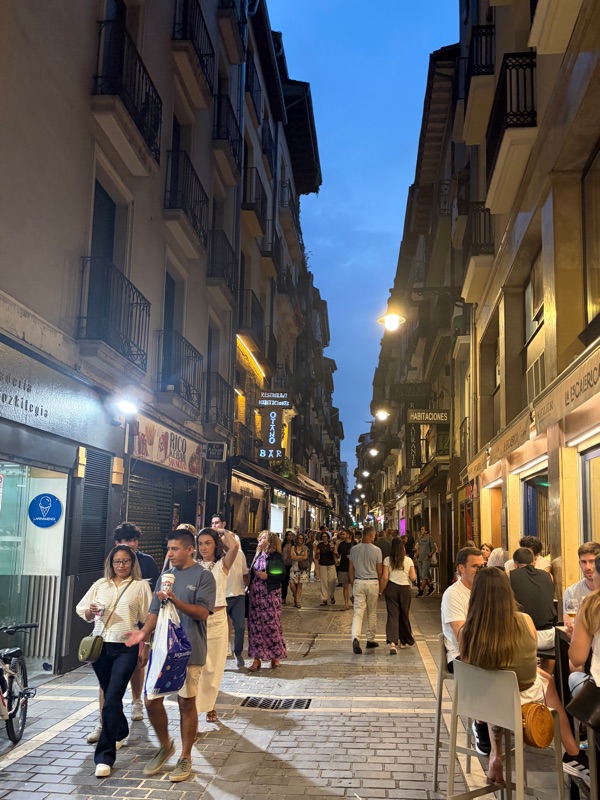 I got into Madrid, exhausted. My Pacer Poles made it and I was able to pick them up with no problems. While waiting for my flight to Pamplona I met two pilgrims who were trying to get someone to share a taxi to SJPP. Before we boarded the plane, a couple of pilgrims showed up, identifiable by their backpacks, and a connection was made. The price of a taxi from Pamplona to SJPP is about €160 but if you can share, it's not so bad. There is a bus that leaves every day for €28 but it leaves at noon so a lot of people miss that connection.