I've been to the Louvre and to the British Museum.
I've seen the Guggenheim.
I've visited the Vatican Museum, Naples, and Pompeii.
They are, of course, spectacular!
However, some of the sweetest art I've seen anywhere
has been in the tiny churches and wonderful museums
along the various routes of the Camino Santiago.
There is treasure to be found each step of The Way!
This will be a photo essay of some of my favorite Camino art.
I'll do my best to make a note of where it was seen,
in case you'd like to see it in person.
Grab a chair and a cup of coffee and settle in...
Unless it is on YOUR garage, graffiti can be quite artistic.
I begin with this carving in the ancient prison door at St. Jean Pied du Port.
See the name "Breton?"
Well, my 5th great grandfather had the last name "Breton!"
I wonder if he spent a night in this cell?


This graffiti was seen walking through Trinidad de Arre.
It asks, "Who watches in this house?"

Pamplona is worth a day's layover, in my opinion.
There is a lot to see there, including the Diocese Cathedral Museum.
On the day I visited, Pilgrims got in GRATIS!

On display are items of Navarrese religious art. There are many images of the Virgin Mary and a large collection of gold and silver articles, with such exceptional pieces as the gothic reliquaries of the Holy Sepulchre and the Lignum Crucis, in the French Gothic style, which belonged to the Crown of Navarre; the reliquary of Santa Espina (15th century); the custody of the Corpus and its shrine, made by silversmiths from Pamplona at the end of the 16th century with rich Eucharistic iconography and parish crosses of great value, such as that of Arazuri. There are also paintings, altarpieces, carvings and other decorative arts.
Address: Catedral de Pamplona (acces via Dormitalería, 3, 31001 Pamplona
Visiting hours: M-F10 a.m. to 2 p.m. and 4 p.m. to 7 p.m. Sat: 10 a.m. to 2 p.m. Sun and public holidays: closed.
Summer (July 15th-September 15th): 10 a.m. to 7 p.m., M-F. Saturday: 10 a.m. to 2.30 p.m.
Entrance fees:adults: 4.14 euros; children: 2.45 euros; groups of over 15 people: 3.15 euros; special groups (OAPs and schoolchildren): 2.50 euros; pilgrims: 2.30 euros; youth cardholders: 3.10 euros.
Visiting hours: M-F10 a.m. to 2 p.m. and 4 p.m. to 7 p.m. Sat: 10 a.m. to 2 p.m. Sun and public holidays: closed.
Summer (July 15th-September 15th): 10 a.m. to 7 p.m., M-F. Saturday: 10 a.m. to 2.30 p.m.
Entrance fees:adults: 4.14 euros; children: 2.45 euros; groups of over 15 people: 3.15 euros; special groups (OAPs and schoolchildren): 2.50 euros; pilgrims: 2.30 euros; youth cardholders: 3.10 euros.


The church at Obanos has a beautiful retablo, and some very realistic statues of Jesus and the Sorrowful Mother. One thing people may not think about is that when many of these churches were built, the general population did not read. And so the sculpture and paintings in the church were a way for people to learn and remember the Bible stories and doctrine of the Catholic Church. I'm sure some of the art made quite an impression on young and old alike! Most Catholic Churches in the USA are bland by comparison,
especially since Vatican II.

 At the Church in Puenta la Reina,
watch for beautiful scroll work.
 Before going into the church,
stop for a moment in front of its 13th-century doorway.
Look at the arches.
The first is smooth,
the second is decorated with pilgrims' scallop shells,
and the third displays some interesting figures
like angels, birds, lions and a harpy, amongst other beasts.
This church, known as The Church of the Crucifix,
dates back to the end of the 12th century
and was founded by the Order of the Templars.
After the Order was expelled in 1312,
the military order of St. John of Jerusalem
took charge of their assets in the town in 1443.
Around the middle of the 15th century,
the convent of the Sisters of St. John was built next to the church,
as well as a hospital for caring for pilgrims making their way to Compostela.
The Brotherhood of the Crucifix took over hospital care in 1469,
giving its name to the church.
Having been abandoned for years
during the Desamortizaciones (Disentailments-confiscation of church property)
and the Carlist wars,
the Padres Reparadores (Priests of the Sacred Heart of Jesus)
took charge of it in 1919,
which enabled it to be preserved.
Inside, you will find a crucifix of curious design.
Those of you with some knowledge of Hermetics
might have ideas about its meaning.
 The beautiful Gothic carving, dating from the first half of the 14th century, has been associated with examples of Rhenish work due to its "Y" shape on wood that replicates a tree with the bark left on. You can also see the Italian influence in the exquisite treatment of Christ's facial features and the positioning of his feet. His expression of pain is notable, accentuated by his arms positioned in a very pronounced "V" shape and the strongly dynamic impression of his torso and feet.
The crucifix is attributed to the Templars, thought there is no evidence to confirm this, as the first document that makes reference to this piece dates from 1325 and the Templar Order was expelled in 1312. Local legend tells that the crucifix was donated by some German pilgrims who, on returning from Santiago, wanted to show their thanks for the kind treatment they had received in the pilgrims' hospital in Puente la Reina by donating to the church the cross they had carried on their shoulders during their pilgrimage
especially since Vatican II.


watch for beautiful scroll work.

stop for a moment in front of its 13th-century doorway.
Look at the arches.
The first is smooth,
the second is decorated with pilgrims' scallop shells,
and the third displays some interesting figures
like angels, birds, lions and a harpy, amongst other beasts.
This church, known as The Church of the Crucifix,
dates back to the end of the 12th century
and was founded by the Order of the Templars.
After the Order was expelled in 1312,
the military order of St. John of Jerusalem
took charge of their assets in the town in 1443.
Around the middle of the 15th century,
the convent of the Sisters of St. John was built next to the church,
as well as a hospital for caring for pilgrims making their way to Compostela.
The Brotherhood of the Crucifix took over hospital care in 1469,
giving its name to the church.
Having been abandoned for years
during the Desamortizaciones (Disentailments-confiscation of church property)
and the Carlist wars,
the Padres Reparadores (Priests of the Sacred Heart of Jesus)
took charge of it in 1919,
which enabled it to be preserved.
Inside, you will find a crucifix of curious design.
Those of you with some knowledge of Hermetics
might have ideas about its meaning.

The crucifix is attributed to the Templars, thought there is no evidence to confirm this, as the first document that makes reference to this piece dates from 1325 and the Templar Order was expelled in 1312. Local legend tells that the crucifix was donated by some German pilgrims who, on returning from Santiago, wanted to show their thanks for the kind treatment they had received in the pilgrims' hospital in Puente la Reina by donating to the church the cross they had carried on their shoulders during their pilgrimage
The Church of San Roman at Ciraqui is another church with beautifully carved arches. Take a rest here and see what images you can find among the arches.

Keep your eyes open along the road - you never know what you'll see!
In Lorca, even the fountains were art.

The Iglesia San Pedro in Estella is a wonderful stop.
There you will see images both Christian and pre-Christian.
There is a curious statue in the cloister that appears to be Asian.
Does anyone know the origins?


Inside Iglesia de Santa Maria in Viana,
we were shown many treasures by the local Priest,
after being invited us to stay for the night.


We had a lovely family style dinner with other pilgrims,
slept on comfortable mats on the floor,
and were awakened by a choir singing outside our window at dawn,
under the light of a full moon.

Outside Logroño, we came across a festival
and the tiny chapel had the beautiful Virgen de Cuevas inside.

At Ventosa, the Mother was especially Sorrowful!

If you look carefully, you find "mouthpullers" hiding about:

In Azofra, the Jesus looked especially sad.
They also had another life sized Jesus laying in state on a glass-encased bed
and a dark archway containing some other beautiful sculptures.


The Church at Santo Domingo del Calzada really DID have live chickens inside.
I don't think that qualifies as "art" but it sure was interesting.
It was forbidden to take photos, but I found this one on the internet.

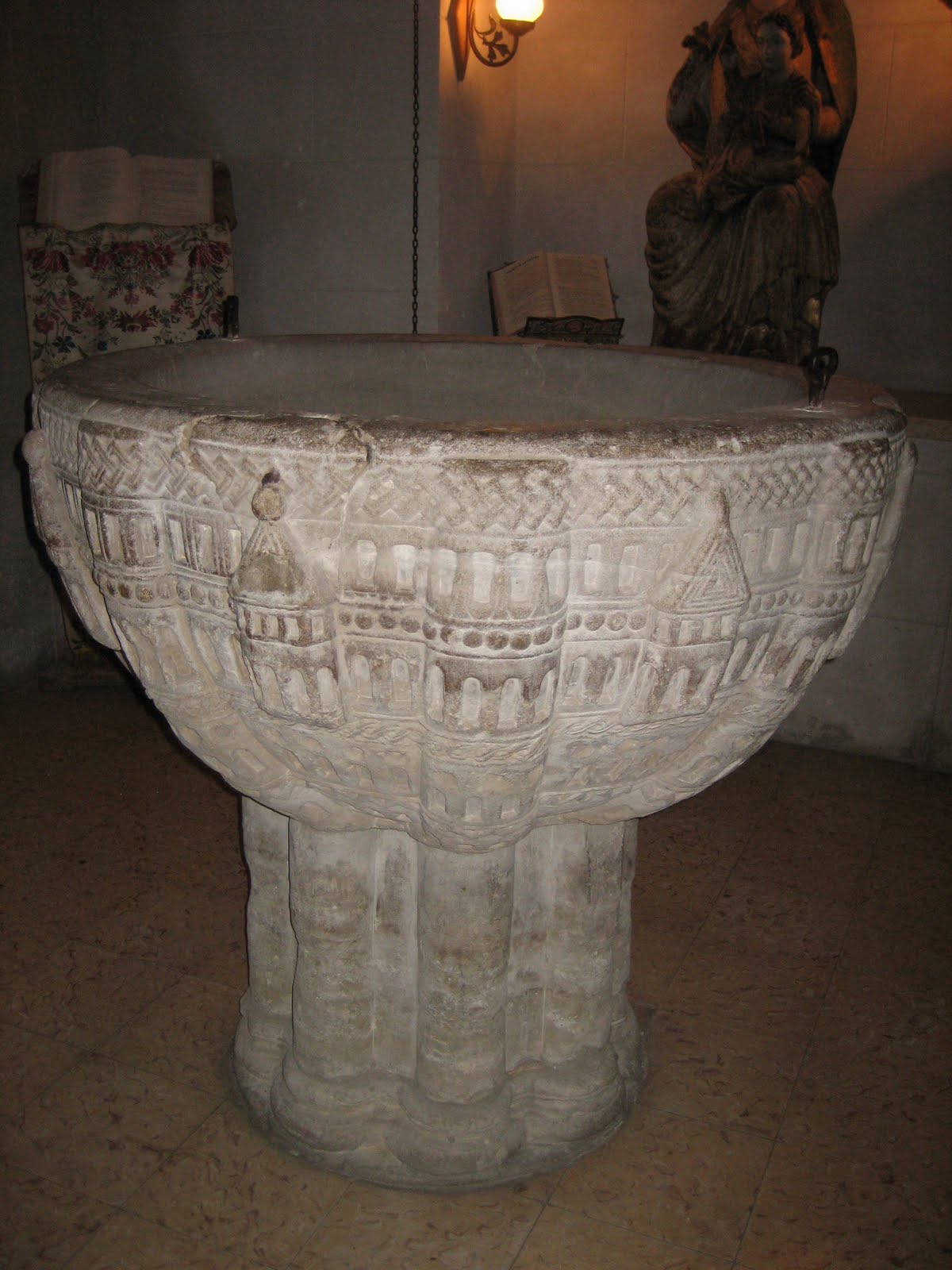
Redecilla's church had a beautiful stone carved baptismal font.
Among the huge gold retablo I found these lovely angels.
I also found this interesting Holy Mother.
But where is her crown?
Was it stolen by some hungry pilgrim?


Passing Tosantos, look to your right
and you will see the Ermita de la Virgen de la Pena.
If you are lucky, you will stay at the albergue at Tosantos
and take part in the tour which is offered.
No photos of the inside are allowed,
but I promise you will not be disappointed.

The Church at San Juan de Ortega is worth a visit.
There you can see the souls in Purgatory begging Mary's help
and there are dragons on the ceiling!
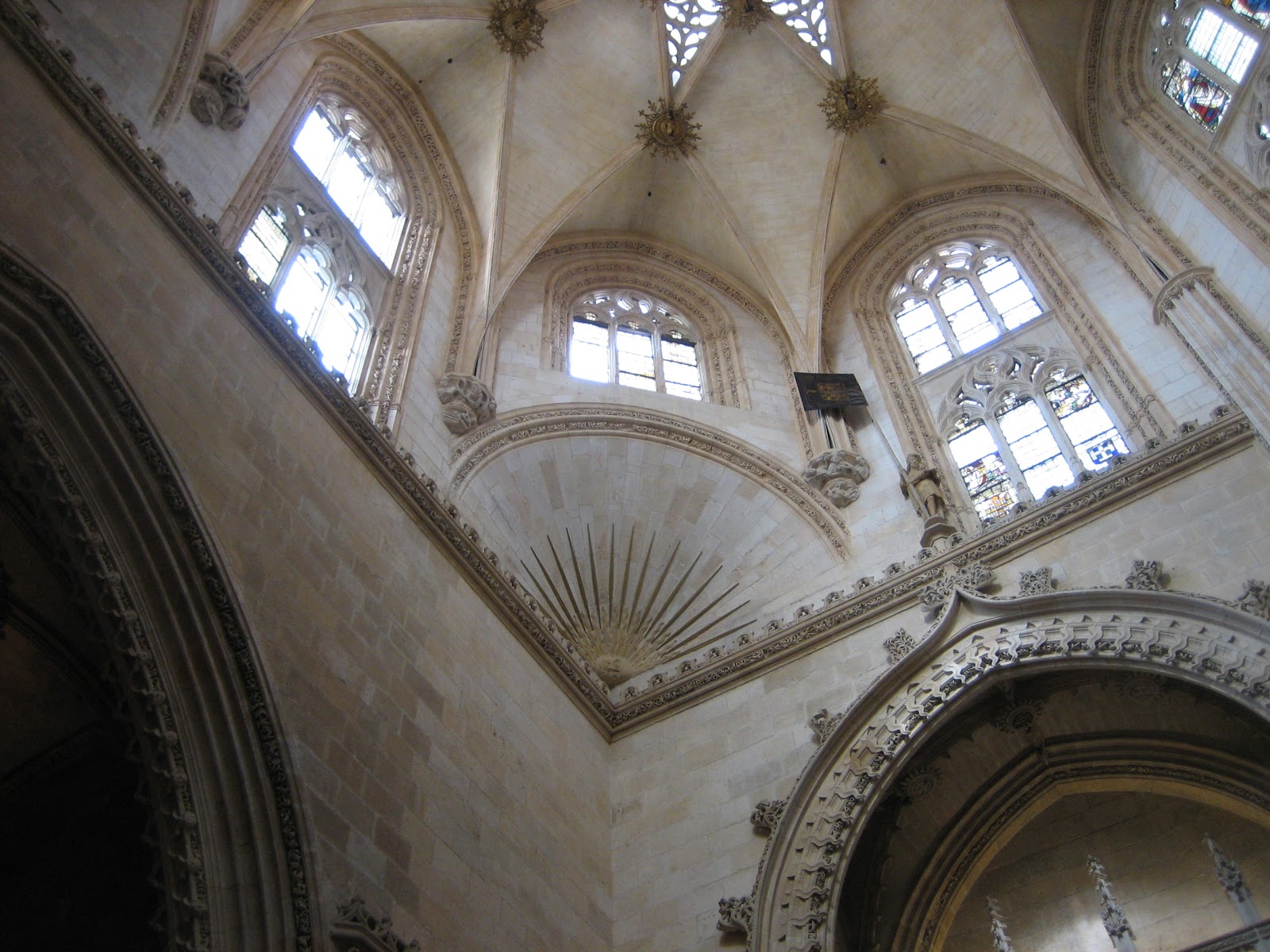
Always look up!

I have spent hours visiting the Cathedral at Burgos,
and it really deserves its own blog,
but here are a few of the treasures you will see there.

 |
| Choir Stall Seat |
 |
| Always look UP! |

 |
| Which Mary is this? |


I saw this interesting painting inside the little church at Hornillos.
Anyone know what it depicts?
As I often found in towns that had been nearly abandoned,
the art was being destroyed by the elements.
A shame, really.

San Anton was a wonderful place. What can I say? Even the bathroom was artful. This church must have been spectacular in its time.


San Nicholas was stark , but still inviting.


The Leon Cathedral will take you many hours to explore.
Too many photos to post of that!
Keep your eyes open when walking through towns and villages.
There are often interesting sculptures on the streets,
like this pilgrim who seems to basking in the sun,
resting his feet,
and reflecting on his journey.
Or maybe he's dreaming
about that lovely Pilgrim's Plate
he had for supper.

In Villar de Mazariffe you will find Albergue El Refugio de Jesus.
The owner allows pilgrims to decorate the wall there,
and it certainly is interesting!
There is even "art" out in the yard!


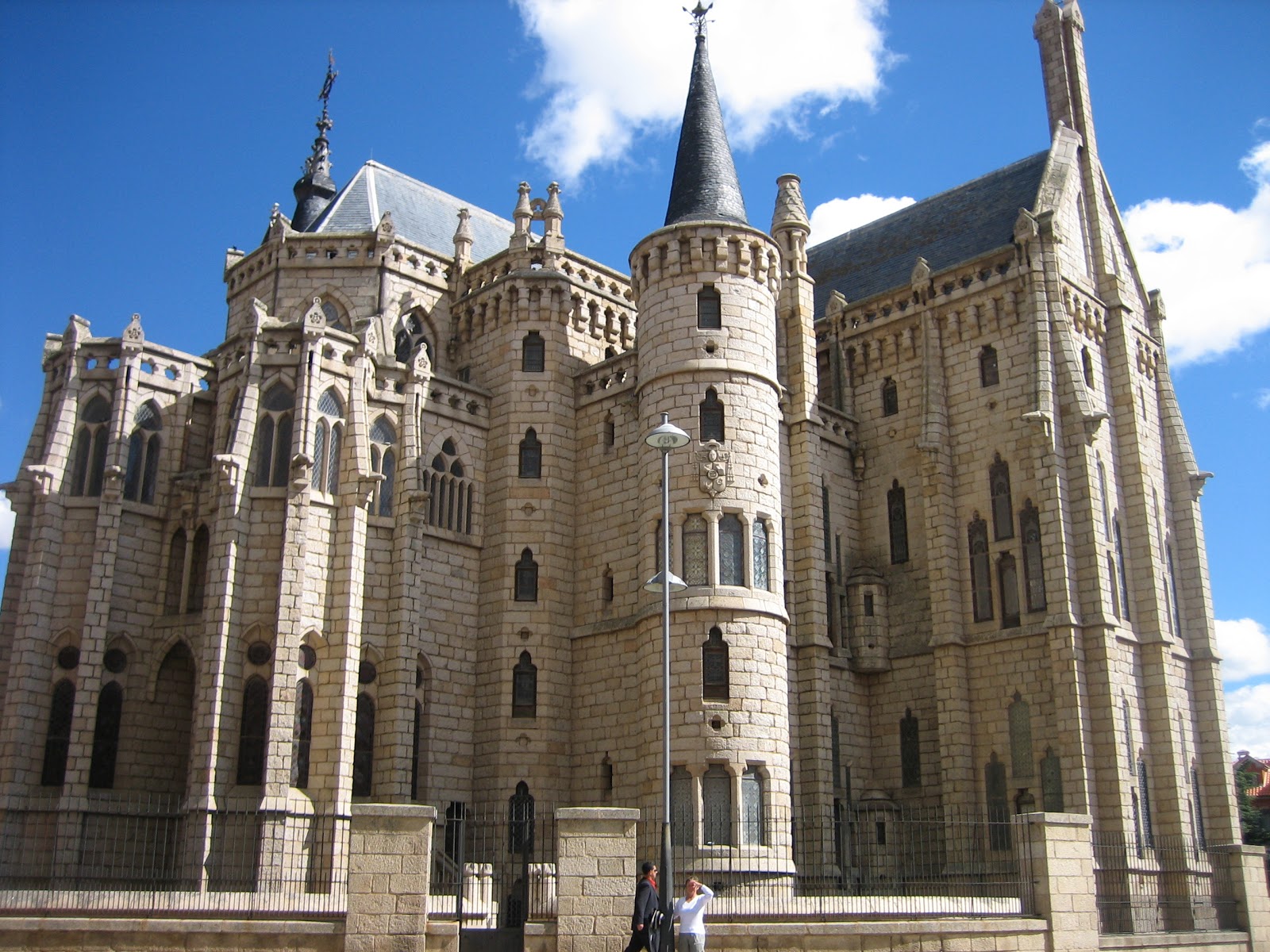
Astorga boasts both a Cathedral and the famous Gaudi Palace.
Be sure to take time to visit both!
Astorga also has a wonderful museum of history.
I found this interesting St. James at Rabanal's albergue.

This colorful door was somewhere between Molinaseca and Cacabellos.
Anyone remember it?

And then there were the GIGANTES!

This Christ Statue at Vilafranco del Bierzo made me want to cry.

And this giant at Vega de Valcarce made me LAUGH!

At Ponferrada, you can visit a the castle!

And soon, you reach Santiago, where there is the Cathedral.
The art there leaves an impression,
especially the Botafumeiro.
It is a sight to behold!
I'll save that for you to see in person.
Well, I hope this blog will encourage you to walk a bit slower.
Take your time.
Don't be afraid to take little side trips
into unexpected places along the Way.
And while you're seeking treasure along the Camino,
don't forget to look
into the kind eyes of those who serve you,

into the weary but happy eyes of your fellow Peregrinos,

and into your own eyes
when you pass a mirror.

That is where you will see
the greatest beauty of all!
Live is so good!
Savor each moment!
Buen Camino!
Annie
* * *
* * *
Note: If you would love to walk the Camino Santiago,
but are not quite ready to go it alone,
consider joining Annie
on one of our small, affordable Camino walks.
For more information see our website
at this link: AnnieWalkers Camino