Here I go...

One Adventure After Another!
Showing posts with label pickpockets. Show all posts

Wednesday, April 23, 2014

DIY Secret Pockets

I have been alarmed at the increase in reports about pickpocketing and theft on the Camino.
I have tried various types of money belts and secret pockets and in the end I had decided I liked the kind that threads onto a belt (which goes around your waist) and hangs inside your waistline. But there is always the threat of someone cutting that off and grabbing it and what do you do with it at night, etc.

So I decided to sew some secret pockets 
into my Macabi Skirt.

This project would work on any skirt or hiking pant.
You just need to be aware of beltloops, and not sew over them.
I did that the first time around, and had to remedy it.

This entire project (with mistakes and corrections) 
took me a total of 20 minutes.
Here's how I did it.

First, you will need a "secret pocket" of some type.
I use old money belts I find at Goodwill.
I had several old neck versions like this:


You will also need some strong but flexible fabric 
to make the little extra "tab" that the pocket hangs from.  
I think some strapping or strong ribbon would work great.
However, I felt old wool clothes, and had some interfacing fabric I'd cut out of some pants
and so I used that.
You can see it under the pocket.


The first thing I did was cut the straps off the pocket.


Next, I folded a piece of the interfacing into a strip 4 thick.
It was very thin and I wanted it to be strong.
I serged this strip onto the top of the pocket,
being VERY careful not to cut the pocket itself.
If you don't have a serger, you could just zigzag this a couple of times.


Here is the pocket with the strip serged on.


Here is the front with the serged strip folded up.


Next, I serged the sides of the strip.
Here is where I made a mistake and serged down the closing tab of the pocket. 
See?


Luckily it was easy to fix when I found it.
I just used a seam ripper and took out those stitches.


Next, I topstitched the strip onto the front of the pocket.

Here is the finished pocket with the strip sewn on,
and the mistake stitches removed.

It still opens nicely.
You have to be careful and be SURE you catch the top of the pocket
but stay VERY close to the edge so it will still open.

Here, I've placed the pocket on the inside of my skirt.
NOTICE the opening FACES THE inside of the skirt.
This is so when you flip it to the outside,
the pocket is facing outside.
You'll see...

This part is tricky.
You must sew the pocket onto the waistband of the skirt or pants.
You must be careful to stretch the waistband if it is elastic.
In my case, on the Macabi, the waist is elastic.
In some pants and skirts, it is not such an issue.
When stretching the bottom layer, 
you must hold BOTH layers and pull them apart,
and at the same time, keep your pocket in place.
It takes some sewing practice.


Here is the pocket sewn into my Macabi skirt.

This is what it looks like from the outside.
You can't even tell it's there.
I did make a second mistake and sewed across one of the belt loops.
I fixed that by sewing two short lines DOWNward on each side of the loop,
then removing the stitches going across.
Does that make sense?

Here is the pocket from the inside of the skirt.
The soft part is toward your body and the "pocket" part is facing the skirt.


Here is the pocket flipped to the outside.

Here is the pocket flipped to the outside when I'm wearing the skirt.
I'm so stoked!

Remember, this is NOT how you wear the pocket.
It should always be INSIDE your skirt!
I just flip it out to get into it when I'm in private, like in the bathroom.
NEVER in a public place.

* * *

After I finished, I rounded up another pocket I had laying around
and I put it into my black Macabi skirt.

I measured out some lining fabric and doubled it.


Here, I have made the Strip (using my serger)  from which 
the pocket will hang.


Here is the back of the pocket:


And here is the pocket flipped out for access.
I can't believe I haven't done this until now!


Again, this is just to show you how the pocket flips out.
NEVER take it out in public.
Access it in the privacy of the bathroom or your bedroom.
I'm going to put pockets in EVERYTHING!
Next, I have a blog on putting pocket in my HAT!

Of course, what this means is that I will have to 
remove everything from these pockets at night
and put them into the pockets I"m going to sew into my night clothes,
or ..
just wear the skirt or pants to bed and be dressed for morning!

Think it through,
but whatever you decide to do,
BUEN CAMINO!

Love,
Annie

Monday, March 17, 2014

Which Money Belt Is Best for You?


Most pilgrims agree that a money belt is a necessity on the Camino Santiago.
It makes the most sense to use an ATM card 
and withdraw €200-€300 when you find a bank, 
and then spread that cash out over several days. 
Using my budget of €20 per day, 
one withdrawal can last me up to 10 days.

I take out €20 each morning 
and carry it in a change purse
that is easy to access.

The rest travels in a money belt with my passport and credit card.

There are many options for carrying your cash on the Camino.

Here are a few:

Neck pouch.


Review: I do not recommend these at all.
First of all, the strap around your neck is a dead giveaway.
Thieves have been known to grab these and cut them with a blade.
The ones that cannot be cut could strangle you if the thief was on a bike.
I just don't think they're safe at all.

Leg Safe.


Again, I do not recommend these.
I have seen pickpockets on the Metro
drop to their knees and run their hands
up a man's pants, because they know this is a popular option.
It only takes them a second
to grab your leg safe 
and jump off the train!

Waist Belt.

A regular waist-band money belt.
You can find these in all travel stores.
You can also find them in the Rick Steves travel store.
The are a zippered flat pouch that you wear around your waist.
The compartments are large enough for your passport,
and often have separate places for credit cards and cash.
They have a snap buckle that is plastic.

Please note this belt is to be worn UNDER your clothing, 
not over.


Review:  I wore this type of belt for several years. Sometimes it was uncomfortable because it continually rode up unless I tightened it, in which case it felt binding.  My passport and cash often was damp with sweat. But I still recommend this type of belt over a neck-style.

Bra Caddy

Here's another option.
I don't think it would be too comfortable backpacking,
but hey…


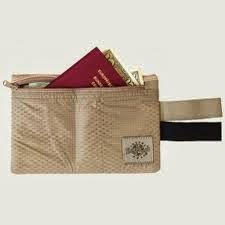
Hidden Pocket.

This is one of my favorites. 
It is a pocket, with various compartments. 
It is big enough for your passport, cash, and credit cards.  
It has two loops, one brown and one black, 
so you can wear it over your belt, 
then tuck it into your skirt or pants.  

It's easy to access. 

I like wearing this along with a regular money belt. (see below) 
It comes in different colors.
 I like the tan because it can't be seen under light clothing.


Standard Money Belt

In addition to the money pouch above,
this year I bought a regular money belt.
I bought the one made by 
Binh,
in a polyester weave.
It is lightweight,
not bulky at all, 
and the zipper is quite long,
so there's space to store several large bills.

The belts can be purchased in leather as well.
I tried this belt one year and discarded it.
It's just not convenient to me.
For a man, it might be a good way to store extra cash,
or for a woman who wears pants with belt loops.
But I didn't care for it.


Splitting Up The Cash

However you decide to carry your cash and cards,
it's probably a good idea to split it up.
Carry some in one belt,
and some in another.

Dummy Wallet

Some people carry a "dummy wallet."
This is a wallet with a credit card or two
that are outdated,
maybe a couple of €20 or €50 bills.
In case of pickpocket or theft,
this wallet can be surrendered easily,
and you're not out your entire bank!

Here is a good blog on what to carry 
in a "sacrificial wallet."

Whichever money belt you decide on,
I suggest you fill it,
and wear it around your hometown for a few days,
so you will know whether or not 
it is going to be comfortable on the Camino.


ON THE CAMINO
Never, ever leave your money, credit cards, passport,
or anything you cannot afford to lose
unattended.
Never leave it with another pilgrim
no matter how friendly they appear.
On my first Camino, I met three young people
whose Camino ended after 3 days.
In Pamplona, they left their bags
with a friendly fellow pilgrim
they had walked with from SJPP.
The "pilgrim" had targeted them
and when she agreed to watch their bags
while they showered,
she robbed them of all cash and credit cards,
and vanished in the Pamplona night.
Sad but true.

When you shower, put your valuables into a 
zip lock bag, or special waterproof bag 
and 
TAKE THEM INTO THE SHOWER WITH YOU!

* * *

And remember,
NEVER get into your money belt
in a public place.
Access it in private each morning,
in a bathroom stall if necessary,
taking out your cash for the day.

When you go to the ATM,
go with a friend when possible.
Have them turn facing outwards,
while you get your cash.
And then immediately go somewhere
you can put your cash away
out of the public eye.


Watch out for children who want to "help" you!
Keep your hand over the slot where the money comes out.
See my post on pickpockets here:
PICKPOCKETS

At night, don't just leave your money belt and valuables by your bedside.
Be sure they are safe where nobody can pick them up and walk out with them.
I often stealthily tuck mine into the foot box of my sleeping bag.

The fact is, there is very little theft on the Camino.
But it does happen.
Thieves look for an easy target, so...

Don't be paranoid, 
but don't be naive.


And you will have a
 Buen Camino!


Tuesday, December 03, 2013

Getting from Madrid to Pamplona and more on Pickpockets


Getting to Pamplona From Madrid

FROM MADRID, you can fly, 
take the train, or take a bus.
Arriving in Madrid is a treat! 

The airport is very modern and beautiful! 

Madrid Airport

Flying is nice, but Spain really is a bus country. Many bus companies offer good, clean and safe service across the country, and most of the buses are beautiful Mercedes Benz buses! Nothing like the old broken down Greyhounds you find in the USA!
An ALSA Bus

There are both regional bus companies and a few national ones. ALSA is one of the national bus companies, and one way to get from the airport to Pamplona when you first arrive.

A CONDA Bus.
 CONDA is another bus company that takes people from the Madrid airport to Pamplona.

If you fly into Madrid, there are buses that leave directly from Terminal 4 at Barajas. There is a machine where you can buy a ticket at the exit near the taxi parking  The machine takes credit cards or cash (euros). 


On ALSA, you have to change buses, usually in Burgos or Zaragoza, which makes the trip a bit longer. However, it is not a difficult change, especially if you speak a bit of Spanish. 

The CONDA buses go direction from Madrid to Pamplona with no change. This option is the also cheapest, coming in around €25-35.

Arrivals from North America, Asia, South America or Australia are better served from Madrid. Catch a bus directly from the airport Terminal 4 (where most international flights land) to Pamplona or take the metro (or Circanius train) from Madrid airport to Atocha metro station where you can connect with the high-speed train (AVE) to Pamplona in 3 hours. I have done this, and to me, it's easier just to hop on a bus at the airport and I'm on my way to Pamplona!

Arrivals from Europe, fly directly to Bilbao, Biarritz or Zaragoza then travel by bus or rental car to Pamplona in less than 2 hour drive.

CATCHING THE BUS

There are ALSA buses to Pamplona 
several times a day.
You must change buses once.
Check schedules at www.alsa.es 

There are CONDA buses going directly to Pamplona. 
No stops, no changes.
Check schedules at www.movelia.es

The prices between ALSA and CONDA buses differ by 10-30 euros. You can purchase your ticket online or at the airport. I suggest you wait and buy it at the airport in case of flight delays, or just be sure to give yourself plenty of time.

GETTING TO T4 in MADRID

Your ticket should tell you 
which terminal you are flying into.
If you are purchasing online, be sure to give yourself enough time to get off the plane, go through customs, pick up your baggage (not suggested to check bags), and get to the T4 terminal.
Your ticket will indicate where you are landing - it will say T1, T2, etc.

There is a bus going from terminal to terminal in Madrid. It costs less than 2 euros and can be caught downstairs and out front of your arrival terminal. Last time I took it, it was a blue/green bus and to the RIGHT after you walked out of the terminal.

ASK FOR HELP.

Find someone wearing a GREEN jacket and ask if they can help you. Or find the Information desk. They will speak English there. You will recognize it because there is a large yellow "i" above it.
Information Desk
Tell them you are looking for the ticket office for the CONDA or ALSA bus to Pamplona. (whichever you decide on) They will direct you. 

Most of the signs in the Madrid airport are in English as well as Spanish. So it's really easy to find your way around - it's just LARGE!  They also give you the time it will take you to walk to the gate which is helpful.


Getting to Other Terminals

I find the bus the easiest and safest. To get a shuttle bus, the boarding platform is just outside the exit. They often allow you to purchase tickets right there next to the bus – so watch for that. This bus also goes into downtown Madrid. ASK. Sometimes the line is long, but it goes fast. 


The bus from T1 to T4 takes about 20 minutes. 

Going in direction T1 to T4, you want to be on the 1st Floor at the departures level.

(Going direction T4 to T1, you have to be on the Arrivals level, which is the Planta Baja, Lower level)

The terminal to terminal bus runs every 5 minutes between 6:30 a.m. and 23:30. From 23:30 - 1:50 a.m. it runs every 20 minutes; from 1:50 -6:30, every 40 minutes

Getting to your gate at T4 could be a long haul. But it's very well marked, with lots of indication about how much time it will take (though the times posted are very generous and you usually arrive in much less time than they indicate).

A tip -- The elevators in T4 are usually much quicker than the escalators because of the distances between upper and lower levels. 

There is an excellent blog on taking the shuttle into the city at this link:


Taking the Train from Madrid to Pamplona 


FINDING THE RENFRE CIRCANIUS

When I was there last year, the Circanius RENFRE office was downstairs right next to where you go through the stiles to catch the train. It was very tiny and could have been a temporary office. It was only staffed by one person, and the wait was long, so don't depend on buying your ticket there if you're in a hurry. You can ask at the info desk in the airport and they will direct you.

In the airport, at the RENFRE Circanius station you can purchase a Tarjeta Dorada card for 5 euros. Then you can just show it to bus or train agents and possibly get nice discounts. Here is a link to more information about that card: 

This card is mainly for train travel, but I even got a discount at the museum in Merida with my card. It never hurts to ask! 

Again, when you arrive in Madrid, you will arrive at either terminal T2 or T4.  You can take the METRO to Atocha Metro Station and walk to the Renfre Station. Or you can take the Circanius to Atocha Station. It takes you right into the train station.

Atocha is the main train station in Madrid. There, you will find trains to destinations all over Europe. It's a big place and is beautiful inside. 

Atocha Station
The Circanius is a train that goes from the airport to Atocha and back all day long. You catch it on the lower floor of T4. Get your ticket from the tiny Renfre office right at the entrance to the train, or from the kiosks. 


There are signs in the airport that will lead you to both the Metro and the Circanius. 

If you are traveling by train, BE AWARE OF WHERE YOU ARE. They do not announce the stops. This is not such a problem during the daytime. You can watch for signs out your window.  But at night, the signs are difficult to see. Don't be afraid to ASK people sitting near you. They are used to tourists and are generally very helpful.

If you do decide to take the train, here are a few videos that will help you become familiar with the territory. Sorry, they're in Spanish, but you can pause them and study the screens on the ticket machine. 

(Often if there is a local, they will help you. Look for young people who may speak English.)


You want to choose ADULTO IDA  (Adult one way) and then your destination.

IF YOU TAKE THE METRO ... WATCH YOUR BELONGINGS!
It is like being in a sardine can and the pickpockets are working!
Be sure your money, cards, cameras, and electronics are really secure.
If you have zippers, I close them with a safety pin or even wire until I get to my destination. Hold your hand over your purse or pocket.  
Be AWARE. 

I know I harp on this, 
but it can save you some grief. 
One year in Barcelona, Joe and I got slimed with the "bird poop" scam. We knew what was going on and as soon as the guy approached, we yelled at him. He ran. If we had not know about it, we would have thought he was just a nice man in a business suit wanting to help us.  And we could have lost a lot.

Read my blogs on pickpockets.  
Know their schemes.
I'm going to post photos at the bottom of this blog to remind you.

Getting to Pamplona From Other Cities:

From Bilbao (169km)

No trains available to Pamplona.
Car (1.5 hours) Direction Bilbao-San Sebastian-Pamplona. Take the A15 from San Sebastian direct to Pamplona. You can also go via Bilbao-Vitoria-Pamplona, 2.2 hrs. We don't recommend this route as it has lots of curves and it’s not free either!
Bus (1.5 hours) Arrive to Bilbao ś Central Bus Station and take La Burundesa autobuseslaunion.com Tel: +34 944 271111.

From Biarritz (128km)

No train available to Pamplona.
Car (1.5 hours) Take the A63/E70 & cross the border into Spain. Stay on the E70/A8 direction Biarritz- Irún-San Sebastian-Pamplona.
Bus (1 hours) Bus from Biarritz to San Sebastian 12 noon and 6 pm pesa.net then change for a 2nd bus to Pamplona with La Conda condasa.com there are 7 daily buses starting at 7:15am and last bus at 8:30 pm. Telephone +34 943 461064

From San Sebastian (85km)

Train (1 hour 45) Train services from San Sebastian take about 1
hour 45 min to the Pamplona station, which is about 2km north of the old town. Tickets can be booked online in advance (strongly recommended) at Renfe.com.
Car (1 hour) Take the A15 direct to Pamplona and enjoy the scenery. Bus (1 hour) La Conda condasa.com there are 7 daily buses starting at 7:15am & last bus at 8:30 pm. Telephone +34 943 461064.

From Zaragoza (181km)

Train (2 hours) When you arrive at Zaragoza Train Station to connect to the High Speed Train (AVE). Tickets can be booked online in advance (strongly recommended) at Renfe.com.
Car (2 hours) Take the A2/E90 AP68 (toll roads) A68 direction Zaragoza-Tudela-Pamplona.

Bus (2 hours) La Conda condasa.com there are 7 daily buses starting at 7.15am & last bus at 8.30 pm. Tel: (0034) 976 333 372

AVENIDA DE AMERICA STATION.
Other buses to Pamplona will leave from the Avenida de America bus station in Madrid. Here is their address:

Intercambiador de Avda. de AméricaDirección: Avda de America, 9. Planta -1 C.P: 28028 Andén: 27 (Salidas y Llegadas) Planta -1
Horario: 5:30 h. a 01:30 h. (Largo recorrido) 

There are buses going regularly all day long from Madrid T4 to this station. You catch the bus outside the T4 terminal and it costs between 2-3 euros. The bus station is usually the last stop, but ASK the bus driver to please tell you when you arrive. You may have to walk one or two blocks - ask the bus driver when he drops you off to point you in the right direction.

How to Read an Horario (schedule)
If you are over 60, look for a box that says “Edad Dorada” which means “Golden Age.” This will get you a nice discount from 30 euros down to about 23 euros, depending on the day of the week.

IDA means "One-Way." 
IDA y VUELTA means “there and return.” 
SALIDA = Departure Time 
LLEGADA = Arrival Time 
ORIGEN = Origen 
DESTINO = Destination 
DURACION = Duration of Trip 
PRECIO = Price 
PRECIO PROMO – Promotional Price* 
Sometimes there is a special price war 
going on

PLAZAS – LIBRE = This means places are not assigned. You can sit anywhere. Some have assigned seats, so check your ticket when you get it.

LMXJVSD – These are the days of the week this bus/train runs: Lunes (Monday), Martes (Tuesday), Miercoles (Wednesay), etc.Learn the days of the weeks in Spanish. It will make your trip much simpler. 

Be aware that unlike USA calendars, calendars in Spain begin on MONDAY and end on SUNDAY, so it can be confusing.

If you have updated information or questions, please post them in the comment section.

Buen Camino, Peregrinos!

******************
A few photos to enlighten you!


The above photo shows a common scam along the Camino as well as in the large cities of Europe. Bright eyed, beautiful teenagers will approach you with a folder, or a clipboard, wanting to tell you about deaf people or some political issue. As soon as you see them approaching, WAVE THEM OFF AND SHOUT "NO!"  And be very aware of your pockets. See the girl picking the pocket of the man listening to the other pretty lady?

A girl watching for your pin number.
She has the pad positions memorized.
If someone is standing too closely when you are at the ATM, wave them back and even yell at them if they don't move!  It's best to do banking in the larger cities with a partner who can stand back to back with you and watch your surroundings. Be aware of quick handed money grabbers. Keep your hand over the slot that distributes the cash and the card.  Don't be paranoid, but don't let your guard down. They watch for distracted tourists.  If someone wants to talk to you while you're at the ATM, shout them away!  No need to be polite. They count on that!


Haha! 


I have seen this scam in action on stairs and escalators.
Someone in front of you will drop a bunch of change, 
or a package, and items will scatter.
They count on your help picking things up.
While you are helping, their partner is helping themselves to your goods.
I know it's tough, but walk on by.

Yes, they DO!

I"m just reading the paper… and making some money!

This is not the Madrid Metro, but this is how crowded it can be.

Don't trust anyone. Even nice old grandpa types, and ESPECIALLY if they're holding a sweater or jacket over their arm!  Move away from them! Put your back against the wall if you can.

Distracted by a Street Performer while the pickpocket's partner gets the goods.

How they work with a jacket over their arm.

It's not just men. It's women like your sister, mom, or child.
So sorry to have to post these photos, but you need to be aware.
Please read my blog on pickpockets.
These folks don't think like you do.
They are proud of what they do and have no shame in getting caught.

Know what to expect.
Stay alert.
Then relax and have a Buen Camino.