Here I go...

One Adventure After Another!

Thursday, February 15, 2018

All About Tapas and Pinchos

Future pilgrims often ask me, "What do you eat while on pilgrimage?"  Well, the answer for me is, "Anything they serve in Spain!"  The food there is SO good, so tasty, so healthy, I'm amazed that I lost 20 pounds on my last Camino.

There is always the Pilgrim Menu or Menu del Dia. However, I'd like to tell you a little about what I have learned about another wonderful option... TAPAS!

Even the smallest villages often have a bar and a "bar" in Spain is not the same place you think of when you say "bar" in the USA. Yes, you can buy beer, wine, and mixed drinks. But you also can get coffee, breakfast, and some pretty good eats there!

It is said the tapa originated in Andalusia as a small snack to accompany sherry. The bartender would cover the glass of sherry with a saucer (or tapa) to protect it from the flies. A good bartender would decorate the plate with a tiny savory snack, and that evolved into these luscious portions we now call tapas.

  TAPA vs. RACIÓN
Something to remember is a tapa serves one. Tapas are often called "pinchos" in southern Spain. A "ración" is a larger serving, usually for 2 to 3 people, or one hungry pilgrim! I've taken these photos from the internet. Some would be considered a "tapa" but the larger portions are definitely "raciónes."  You quickly learn the difference after ordering a time or two.

In some small villages along the Camino, tapas are still free with your drink. Sometimes I was served a plate of olives and other times salted almonds or a bit of meat. Most of the time, however, there was a menu, often written on a chalkboard, and you paid a small amount for your tapas. My advice to you is to try any tapa you see offered - take a walk on the wild side and stretch your boundaries. You are, after all, on an adventure!

But if you would like to at least have some idea of what you will be eating, following is a menu of typical tapas you might see on the Camino Santiago.

ALBONDIGAS are little meatballs. This dish is said to have originated with the Moors. Hearty and filling, they come on a plate of 3 as tapas and 7 to 9 if you order a ración.  They are made of minced pork and veal or beef. They are fried, and served either dry or swimming in a savory tomato sauce.

PATATAS BRAVAS are chunks of fried potatoes coated in a thick sauce. The sauce generally is a spicy tomato sauce but it does vary from place to place, which is why it's one of my favorites. I've seen white sauce like the one above on the potatoes. Don't pass this one by!

GAMBAS A LA PLANCHA are grilled whole shrimp. They are seasoned before grilling and very good. You just peel them and eat them with your fingers. A tapa usually has 3 shrimp. A pincho will have more.

JAMÓN SERRANO is salt-cured ham dried in the mountain air. It is considered a national treasure and in each bar you will see these whole hams hanging.
This ham deserves its own blog, it is so famous. The pigs are fed on sweet mountain acorns, making the meat very sweet and the flavor is deeper than prosciutto. The ham is shaved off in thin slices. It almost always comes with chunks of fresh baked bread. But you also may see it served on top of melon slices or in other combinations.
We saw many pigs on the Via de la Plata, their red eyes shining in the early morning darkness, their grunts startling me!

BANDERILLAS are bits and pieces of meat, vegetable, and/or fruit served threaded on toothpicks. They could consist of marinated fish, hard-boiled eggs, shrimp, olives, or just about anything!  They are sometimes served with bread or crackers. They are to be eaten in one bite, blending the flavors. A banderilla is the sharp barbed stick used to weaken the bull in bullfighting.

CALAMARES FRITOS. These are rings of squid, very lightly breaded or simply dusted with flour and deep fried. They come piled on a plate garnished with a lemon slice. Squeeze the lemon juice onto the fritos before eating. I can make a meal of these!

QUESO MANCHEGO is tangy sheep's cheese. It comes from LaMancha and is one of Spain's most popular cheese. You can buy it all along the Camino by weight and it's good in a backpack for a couple of days if you bury it in your clothing to keep it cool. It is a staple food item when I'm walking. It is served in cubes or slices with bread in the bars. It is often served in combination with jamón serrano or other meat.  Don't miss trying it! If you live near a COSTCO, they sell manchego cheese! I have a hunk in my fridge right now!

ACEITUNAS DE LA MADRILEÑA are served everywhere. Aceitunas are olives. They can be served alone or "de la Madrileña" which means in a nice vinegar/scallion/garlic marinade. I bought bags of aceitunas for under a Euro to carry in my mochila on the Camino.

MEJILLONES A LA MARINERA. These are mussels cooked in a lovely garlicky wine sauce. They may be served in the shell, on the half-shell, or shelled in a bowl of sauce. Usually served with crusty bread to soak up the sauce, eat them with a toothpick.

ENSALADILLA RUSA is a cold potato salad that can contain any combination of tuna, shrimp, potatoes, carrots, peas, peppers, or eggs. The dressing is usually mayonnaise or a home made garlic mayo.


CROQUETAS are a tapa you will find everywhere. The ingredients are greatly varied. The croqueta could be of fish, potato, ham, just about anything. They're little balls of food, which have been rolled in a coating and deep fried. They are always very good and filling!
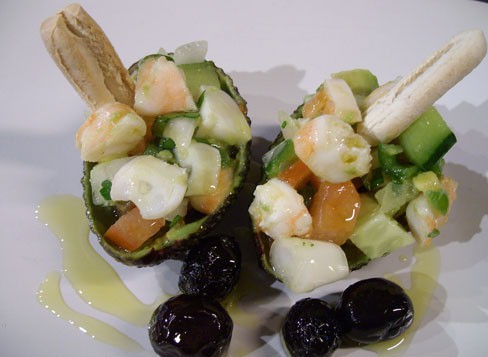
SALPICÓN DE MARISCOS is a cold seafood salad. Ingredients can vary but it is almost marinated in a vinaigrette.

BOQUERONES are one of my favorites! They are tiny marinated white anchovies. Nothing like what you buy in the can, please be sure to try them! They are not "fishy" because they are fresh! Great on a slice of bread! They may come whole or filleted. Sometimes you find boquerones deep fried.

POLLO AL AJILLO is a tapa of small pieces of browned chicken, simmered in a garlic sauce. The sauce can vary. It may or may not have tomato, but no matter...it will be wonderful! Eat it with crusty bread.


TORTILLA. This is not your Mexican tortilla. This is more like a fritata or thick omelette, served in wedges or squares, alone or with ham. It has potato, onion, and sometimes other vegetables. But generally it's pretty straight forward. I love this for breakfast but it's good any time.

FRITURA DE PESCADO is a plate of fried fish and other seafood. It's a bit like tempura.

ENSALADA DE PIMIENTOS ROJOS is a wonderful salad of roasted red peppers and onions. The salad has an olive oil and vinegar dressing. Very rich. As with most tapas, it is great with crusty bread. I bought roasted peppers and put them on sandwiches for my lunch when walking the Camino.

CHORIZO is a garlicky sausage, nothing like the chorizo of Mexico. Made from acorn fed pigs, it literally melts in your mouth!  It is served in many ways. It might be simply slice don a place, as shown above, or you might get it on a slice of bread, as shown in this photo from a Sevilla tapa bar:
You also might get it in a tiny bowl with sauce, as this photo shows:

It can be served cold or hot.  No matter how it is served, try it! You can't lose!

CARACOLES are one of my very most favorite tapas. These are the same tiny snails you see crawling all over the vegetation on the Camino. Stewed in a savory garlic sauce, they are an amazing treat with a cold beer - instant energy! Eat them with your fingers by pulling them out of the shell with a toothpick.


MORCILLA is a savory pork blood sausage. It can be seasoned in a variety of ways. I like some. I don't like others. My advice is to just try it every chance you get. I can hear you saying, "Eeeewwww... sausage made of blood!"  But before you do, think about those luscious, flavor filled bits and pieces you scrape up from the pan when you're cooking pork chops? THAT is pork blood and is what morcilla can taste like. It can be incredibly good! It can be served in slices, but is usually laid on a slice of bread and topped with potato or some other item.

OREJAS DE CERDO are just what they sound like; pig's ears. They are either deep fried or cooked in a savory sauce. Not for the weak-kneed, you might be surprised at their goodness!

To me, these are an excellent example of the way that the Spanish people live the philosophy I love! They respect the animal they are killing and eating by not wasting one single piece! It's the way our grandparents lived, before we got so spoiled with our plastic filled meat cases here in the United States. I have met many people who, believe it or not, have no idea what animal they are eating and never think about how it was raised or butchered.

In Spain, people still live close to the earth and respect her.
That is one reason I'm so in love with that country!

So that's it! These are some of my favorite tapas! As you can see, there are many choices for a hungry pilgrim in Spain. A supper of tapas can be a great option when you're on a budget.

If you have a favorite tapa that I did not mention, please comment. I'll look for a photo and post it.

Buen Camino, Pilgrims, and Buen Aprevecho!

Love,
Annie


Tips for Keeping the Weight Down 2018

The suggested weight to carry (by most experienced pilgrims) is approximately 10% of your body weight. This means if you weigh 160, your pack, including water and food, should not weigh more than 16 pounds.

It's not as difficult as it sounds.

Here are some tips to keep the weight down. Some are my own, and others were given to me by some American Pilgrim on the Camino Facebook Friends.

THE RIGHT SIZE PACK.
Take the smallest backpack possible. I carry a 28L pack - the largest pack I've carried was my old 30L Arcteryx and I've never suffered for space. And don't believe that it's ok to carry a larger pack and just not fill it up. It will not be good for your back. Things will shuffle around. You will get blisters on your feet from the uneven load and you'll find things to carry in that extra space. Just buy or borrow the right size pack to begin with.

CUT YOUR HAIR SHORT!
Or if it is long, braid it.
But don't drag along shampoos, conditioners, and hair products.
Be free!
Just wash, shake it out, and go.
Use the same bar for shampoo and shower.
No comb, no brush, no problem!

NO COSMETICS!
For 6 lovely weeks, go natural.
Don't worry about makeup.
No mascara, no eyeliner, and please, no perfume!
You will be staying in close quarter with other pilgrims, many of whom may be allergic to your perfume.

LOTION? USE OLIVE OIL OR BUTTER.
Both are free.
Both are great skin conditioners.
Grab extra at dinner!

Instead of heavy SUNSCREEN...
Wear a hat and carry an umbrella.
Doubles for sun/rain.

SMALLER CONTAINERS

Deodorant.  I have used two types of deodorant on the Camino.  One is a deodorant stone, which I break into a smaller piece.


I'm old enough to remember using paste deodorant. It is easily applied with fingers.  One year I cut off a piece of regular SECRET paste deodorant and smashed it into a tiny lightweight plastic container. That worked great. Just rub your fingers over the top and apply. You don't have to see it on your fingers for it to work. Solid or gel, either would work. You don't need much. My container is about 2 inches wide and maybe 1/2 inch deep. After about 4 years, it still has deodorant in it.


Toothbrush and Paste.

Ann Brooks suggested cutting the handle off your toothbrush to save weight.

I prefer a lightweight foldable brush you can buy at the drugstore. The handle is hollow so it is very light and folding it keeps the brush clean.  I bought mine at Walgreens Drugstore.


For toothpaste, I take a tiny travel tube. When I run out, I either buy another travel size or just use salt, which is a wonderful cleaner and toughens the gums!

Floss

Helen Beletti suggests a tiny travel size floss container. If you can't find it at the drugstore, ask your dentist. They always have samples.

Duct Tape
Tim McElhannon suggests, "Warp duct tape around trekking poles to use for emergency repairs to shoes and clothing."  This is an excellent idea and I've done this for many years! I used duct tape last year to hold my shoes together the last 100 kilometers.  Here is a photo of someone using pink duct tape, which also marks your poles and discourages thievery. Notice the mailing tube for checking poles on the airplane.


Tenacious Tape and ONE Medicine Bottle
Lisa Morales says, "My first aid kit is an empty medicine (pill) bottle with just the essentials. I use a small roll of Tenacious Tape instead of duct tape. Waterproof and no sticky residue. Fixes tents, tarps, sneakers and blisters. "

Featherweight Undies
Lucy Fox posted, "I have discovered a women's underwear that weighs NOTHING. Hanes Smooth Stretch hipsters. They take up almost no room. Best of all, they are super comfortable and very quick drying, you can wash 'em out and  they are dry in a few hours, and you can probably do fine with a 3 pack which sells for about $7.50 on Amazon."

Dr. Bronners
Nancy Rich said, "I shave my Bonners Soap into a small squirt container that I carry instead of the bar of soap. Each time I am going to use it I add water....shake............and squirt out soapy liquid for hair-body-clothes washing. Once the liquid is out it is lightweight again until the next time I need it and add water again. Lasts a long time."

Try a Shampoo Bar
Personally, I'm hooked on shampoo bars.  I don't like the idea of something spilling into my pack.  You can use the bar for shampooing your hair as well as for bathing. Lightweight and small, I prefer Liggets Bar.  I cut one in half for 6 weeks of Camino. Share with a friend or save for your next Camino.


Aveeno Face Pads
Debbie Garth cuts Aveeno Face pads into halves and carries them in a ziplock bag. Lightweight and convenient!  Count the number of days you need and divide by two!  She also puts vaseline in a ziplock.

Clothing
Clothing should be lightweight and quick drying for the Camino.  If you live in the USA, check your local Goodwill store. They have an "Active Wear" section that is always full of great Camino wear!

Guidebooks
If you are taking a smart phone, consider a guidebook app instead of carrying a physical book.  "Melanie" used to sell a great one for the Via de la Plata. I'm sure there are apps for the Camino Frances as well.

Laundry
Take a dozen big safety pins instead of clothespins. They are smaller, lighter, and will discourage clothing thieves.  Your clothes won't blow off the line with safety pins, either.

I take an elastic clothesline and hang my clothes around my bed for privacy in busy albergues.


For handwashing, take 1/4 of a bar of Fels Naptha in a ziplock. Or wait until you get to Spain and buy and split up a bar of cold water washing soap they sell there in every market.


If you plan on using washing machines, don't bother taking laundry detergent. It comes with the price of the load.

LAYER CLOTHING and Multi-task Clothing
Because you are walking through so many varied microclimates on the Camino, it's best to pack lightweight clothing that can be layered. Instead of a heavy coat, take a featherweight fleece and a featherweight windbreaker/raincoat. Or a fleece and an ALTUS poncho (which blocks the wind nicely).  A lightweight pair of long underwear can double as pajamas or leggings under shorts. A rolled up jacket can double as a pillow. 

A lightweight sarong can double as a towel or a skirt in a Cathedral.

Here are a couple of cool videos that will show you how! Some really cute ideas!


These are just a few ideas of how to keep the weight down.
I'll add to them as people post.
Or message me if you have your own and we'll add them to the blog!

Buen Camino!
Annie

The ALTUS Poncho - 2018


If you hang around Camino forums for very long, 
you'll hear people talking about the ALTUS poncho. 

What the heck IS an ALTUS poncho?

The ALTUS poncho is a rain poncho
but better.

The ALTUS has a large "hump" on the back 
that completely covers your backpack.
When you're not using that "hump,"
it snaps neatly down to the poncho,
making the back flat.

The ALTUS also has sleeves,
unlike other ponchos,
and the sleeves have elasticized cuffs,
so your arms stay completely dry.

Here you can see the coverage with Linda and Patty's ALTUS
The ALTUS both zips up the front,
and snaps up the front,
so a strong wind won't blow it up or off of you.
In fact, it makes a very good windbreaker
for those cold, windy days.

The ALTUS has a large hood,
which fits comfortably over your hat,
whether it is a baseball cap style,
or a Tilley hat with a larger brim.
In fact, though the ALTUS hood has a brim,
I find it better to wear it over my hat,
for stability and better vision.
In other words,
the hat keep the brim of the ALTUS 
from flapping around in the wind,
and keeps it stabilized.
It also keeps the hood up in a way 
that keeps the rain from hitting your face and neck.

The ALTUS is so good at keeping your warm
that I've literally used it
as a blanket at Roncesvalles,
when one of the pilgrims in my group 
didn't bring a sleeping bag, 
and I gave her my own.
I simply put on my longjohns 
and slept with the ALTUS over me
and it kept me toasty warm.

People have asked if it keeps you dry?
It keeps me dry as a bone.
However,
like any other gear, 
you must learn to use it.

You must vent the Altus properly.
in order to stay dry.
Because you are walking and sweating,
the ALTUS will collect condensation,
like any other rain gear,
and you will get soaked by your own sweat.

To keep that from happening,
I always leave the top several inches of the ALTUS open
when I'm walking in rain,
so the heat can escape.
And though you can't help but get a little damp
from condensation of your own body heat,
you do not get soaked if it's vented properly,
and you do stay warm.

If I'm walking on a day where it rains, then stops,
then rains, the stops,
between rains I simply unzip the poncho
take my arms out of the sleeves,
and let it hang loose from my pack.
It stays (unless of course it's  too windy,
in which case I'd wear it to block the wind).
It doesn't come off because of the neck of the poncho.
And then when the rain starts again,
I slip my arms in, zip it up, and off I go!

At the time of this writing (Feb 2016)
the  ALTUS cannot yet be purchased in the United States.
There are several places you can purchase it
at the beginning of your Camino.

In St. Jean Pied de Port, 
Boutique du Pelerin carries the ALTUS poncho
as well as other pilgrim needs.
If you email Pierre, and ask nicely,
he will hold a poncho for you.
You can pick it up and pay for it on the day you arrive.
Just be sure to give him your name, size, color, and date of arrival.
Here is his website link:

In Zubiri, there is a sports shop called Planeta Agua.
It is on the main street of the village.
Here is their website link:
In the past, they have carried the ALTUS,
and I see they take Paypal.
So you may be able to order ahead, pay,
and pick up your poncho when you reach Zubiri.
This might be your best bet if you are 
starting out in Roncesvalles
and did not get your poncho in Pamplona

In Pamplona, Caminoteca is the place to go.
Located in Old Town, they also carry the ALTUS poncho
as well as other pilgrim gear.
The last time I checked, 
the prices for the ALTUS were less here,
so if you're starting by flying into Pamplona
it would be worth a stop to get your poncho.
I'm not sure if they'll hold one for you.
I'm emailing them today to ask if they take Paypal
or if they'll hold a poncho (or sticks)
so come back in a day or two and I will post their answer.

Of course, you can take regular rain gear.
On my first Camino I wore a rain jacket and rain pants.
But the weight put me off and I needed something more lightweight
that would cover my legs and hips.

The ALTUS keeps my feet dry.
I am 5'3" and usually start the Camino weighing around 155.
So I should by most calculations wear a SMALL.
However, I buy a large,
because I like the way the large covers me 
halfway down my legs, 
keeping the rain off my feet.

Also, if you were to be injured or get lost,
the ALTUS can make a very good shelter,
using your walking sticks.
You could cover up with it 
to shelter you from the elements.

Ralph and Toni Marie, from Las Vegas, spent the night on the mountain!
I did meet one couple in 2014
who got stuck all night
on the pass between Orisson and Roncesvalles
because they started too late in the day
and were caught in the dark in a snowstorm.
They snuggled under a bush
praying the Rosary to stay awake,
until it was light enough to see the trail and walk down.
They were lucky they didn't freeze to death!
I've kept in touch with them,
and they did make it to Santiago.
If they'd had an ALTUS poncho,
or two,
they would have had a much more comfortable night!


OTHER PONCHOS

I have tried the Sea to Summit
and the Bluefield Poncho,
both of which can be purchased on Amazon.
I hated both.
The reason was because they did not zip up the front,
and I about had a heat stroke 
just sitting in my living room with the danged things on.
See my review of the Bluefield here:

And remember,
if you wear rain pants and rain jacket,
you'll need a pack cover,
which you do NOT need if you're using an ALTUS.

So,
those are all the reasons I love the ALTUS poncho.
If you have any questions, please list them below.

Buen Camino!
Annie

***
Need help planning your Camino? 
Don't want to walk alone? 
Don't want to race for a bed?
Walk with us in a small group or alone.
Booked lodging!

Tuesday, February 13, 2018

Don't Break the Bank Part 2 - 2018

For men, not breaking the bank means simply bringing lightweight walking trousers or shorts. In summer, bring tee shirts or tank tops. In June, July, and August, you'll have plenty of time to dry them out.  And as I said in my previous blogpost, most albergues have washing machines these days.

Regarding washing clothes:  Twelve years ago everything I took had to be hand washed in a cold water tub provide at the albergue.  Today, with more and more pilgrims walking, many albergues furnish a washing machine and even a dryer.

I also recently discovered several new self-serve laundromats on the Camino - seems these are becoming more and more popular.

***Be aware that Spanish washers use VERY hot water and can ruin your clothes if you aren't careful.***

If you prefer to use washing machines along the way, you do NOT have to take soap. It is provided with the machine.

If you prefer to have your laundry done for you, many private albergues will provide that service for a small fee of €3 to €6. Well worth not having to carry laundry soap. Be aware that Spanish laundry soap is highly scented so if you are allergic, this may not be a good option for you.

In the shoulder seasons, as I told the ladies, just take clothes you can layer.  A warm base layer, a short sleeved shirt over that, and a merino wool or fleece over that is all you will need even if it's snowing!

Unless you are walking a winter Camino, you do not need a heavy jacket on the Camino. A merino wool sweater or fleece is good enough. You may start off with it in the morning, and will peel it off within 20 minutes, I promise.

I always take a set of long johns. Silk is good, as is bamboo and merino wool. Women can get Cuddleduds, which are lightweight and warm. Joe uses polypropylene.  These are great for sleeping in as well.

Scarves:  An extra large, featherweight scarf is really handy for keeping the wind and sun off of you. It can also be used going to/from the bathroom at night or as a dress while you're washing your clothes.

Towel:  There is no reason to carry a high-tech travel towel. In fact, I hate those things. They just smear the water all around.  Instead, check your grandma's linen closet for a worn out threadbare terrycloth bath towel. Then rip it in half and share with a friend.  You just need something that will dry you fast and that will dry itself fast.  If the towel isn't dry by morning, it's too thick. Test it at home before you take it as with all your Camino gear.

Umbrella:  For years, I laughed at people carrying umbrellas. Then I tried it. I'm now hooked and never walk the Camino without an umbrella. This is something I do not take from home because there are very sturdy, inexpensive umbrellas all along the route. I have never paid more than €8 for an umbrella in Spain. I use a STICK umbrella because they won't go inside out in the wind. I stay dry in downpours and probably 20% cooler in the sun than those without umbrellas. It's like walking in the shade. You can also use it as a walking stick. Try it.

Pockets.  You are going to want some pockets. Just be sure they velcro or snap closed and keep nothing of value in them in the big cities.

Secret Pockets and money belts.  Over the years, I've tried various ways of keeping my money, credit cards, passport, and cash secure. Here are my thoughts...

Money belts. I really do not like wearing money belts. They bind me and twist, but it is NEVER safe to keep your valuables in your backpack. Never. Keep these items in a money belt around your waist. You can find money belts at REI, in travel shops or online in the Steve Ricks' website store.  They look like this:


You NEVER take this off except to shower and then, you carry it into the shower with you in a ziplock bag you bring from home.

I do not like neck money pockets. They drag on my neck and give me a headache and they're too easy to cut and run with. Pickpockets know them well.

Secret Pockets.

I'm a big fan of secret pockets.  These can be as simple as a sock safety pinned to the inside of your pants or skirt, but be careful, as safety pins can come loose!  If I were going to use this method, I'd double pin it.

Here are some instructions for a variety of secret pockets:

http://www.instructables.com/id/How-to-make-an-easy-hidden-pocket/

http://expertvagabond.com/secret-travel-pocket/

http://caminosantiago2.blogspot.com/2014/04/diy-secret-pockets.html

http://www.vagabondjourney.com/hidden-pockets-to-carry-travel-valuables/

http://www.fehrtrade.com/article/759/a-hidden-travel-pocket-tutorial

A hidden travel pocket like this one can be purchased online or at a travel store.
It hangs from your belt, tucked inside your trousers.
This type is easy to make and I've added a pattern for a very simplified version.


This pattern is from the book "The People's Guide to Mexico."
It is a cylinder inspired by Papillon, the French convict-turned-writer.
It will easily hold a passport, and at night you can simply take it to bed with you.
A belt, cord, or stout string inserted through the top loop allows it to be worn hanging from the waist inside your clothing.   
Variations are possible. 

Instructions:
Use a durable but lightweight material.
Plain dark colors that match your belt are best.
It's more important that it is safe and sturdy rather than pretty.

The material can be cut in a long strip, 6 inches by 32 inches.
If you like, finish the two short ends with seam tape or zigzag.
Fold it double to 6 x 16.
Leave 2 inches at the fold for the belt loop.
Now sew down one side, across the bottom and back up for about 6 inches.
The remaining gap is for inserting your passport and money.
Leave an opening large enough to easily insert and remove valuables but not so large they may work their way out.
Remember, the pocket goes INSIDE your clothing, not out!!

I hope this has inspired you to look through your closet
to see what you may already have!

Buen Camino!
Annie

***
Need help planning your Camino? 
Don't want to walk alone? 
Don't want to race for a bed?
Walk with us in a small group or alone.
Booked lodging!

Roncesvalles in the Snow April 2012


If you are considering walking a winter Camino or beginning as early as April in SJPP, be informed!  These are photos from April 2012. 

I'm not say do not walk a winter Camino. 
Many love walking in the winter. 
And, of course, every year 
doesn't have this much snow. 

However, you should pay very close attention 
to the weather reports, 
and you ALWAYS LISTEN TO THE LOCALS 
if they tell you the route is not safe. 

If the route is closed 
and you are advised to walk the Valcarlos road,
you should LISTEN AND DO IT.

(There is now a €12,000 fine for walking when the route has been closed!)

Walking the Valcarlos does not mean 
there will be no snow.
It is just a bit safer.

PLEASE register your walk 
with the Pilgrim Office
in SJPP so someone knows 
to expect you in Roncesvalles!

Go prepared with the correct gear.
Take plenty of food and water and shelter 
in case you get stuck.

Be sure your phone is well charged.

This information has been supplied by Navarricano, who lives in Pamplona. He is a member of the Camino Santiago forum:

There has been another rescue in the Pyrenees. Thanks be to God, this woman survived her experience. This article appeared in this morning's print edition of the Diario de Navarra newspaper. The translation and emphases are mine:

Firefighters from Burguete rescued another pilgrim on the Camino de Santiago yesterday. (4 April). The pilgrim was a middle-aged American (U.S.) woman who had turned her ankle. It took firefighters two hours to transport the woman three kilometers along paths completely covered in snow. The woman and her son were walking the Camino, following the Route Napoleon over the mountain from St. Jean Pied-de-Port to Roncesvalles; the Route Napoleon is snowed under at present.

Along the way, she sprained her ankle, and when she reached the shelter at Izandorre, radioed SOS Navarra for help. SOS Navarra, in turn, alerted the fire department in Burguete. This occurred at 4.30 in the afternoon. The firefighters reached the woman's location in 30 minutes, but transporting her to the paved highway, where they had left their vehicle, was quite a bit more complicated: by stretcher and at times walking with the support of the firefighters, it took the group two hours to cover the three kilometers distance.


* * * * *

The Route Napoleon is still covered in snow. It is still too risky to go that way. Yes, she twisted her ankle. Yes, some can justify this as an accident that could happen to anyone, even in summer too, etc. But folks, please... her rescue was complicated by the snow. Thank God she was able to get to the shelter, and thank God they got her off the mountain. but the weather here in Navarra has been cold and nasty for the past two days. More like January than April, and more snow is predicted for this weekend.


Go the Valcarlos route, wear reflective vests and stay on the pavement.

Here are a few more photos to give you an idea of just how much snow we're talking about. Most of these photos are by "javier" from the Camino Forum. These are all taken at Roncesvalles, where there are snow plows. THERE ARE NO SNOWPLOWS ON THE TRAIL!!
This is a cloister that is much higher than your head!


You cannot even see the doors or the signs above them!


This is why people can get lost.


This is a ROOF top of a 3 story building!
If you take the Valcarlos route, you're more likely to see THIS type of scenario in Patricia Herr's blog, "Girls on the Way."


She and her two young daughters took the road, stayed in Valcarlos, and continued on the next day. Be sure to look at days 2 and 3 for good photos of the difference in walking conditions that these taken in Roncesvalles.

Here is a link to their great blog!

GIRLS ON THE WAY

Monday, February 12, 2018

Camino Tips: Check the Free Box 2018

One of the best Camino Tips I can give you is this one:

Check the Free Box!

Almost every albergue has a Free Box. 
The Free Box is a box that contains items 
pilgrims dump when they realize 
bringing everything from home except the kitchen sink 
wasn't such a great idea. 
Sometimes it is a cardboard box out for everyone to see. 
Sometimes it is a shelf on the wall. 
Sometimes it is hidden in a closet behind lock and key. 
If you don't see it and you need something, 
ask!

Why do people dump things in the Free Box, you ask?
Pretend you've begun walking 
and your pack is heavier and heavier as the days go by.  
You begin to take items out and look at them and say, 
"Do I really NEED this?"  
(This is all part of being a pilgrim, so don't feel guilty).  

You make a pile of things that really, 
you can live without.  
You realize that you really didn't need to bring 
that heavy novel or that can opener, 
or the blow up mattress or the 3 fleece shirts, 
or the extra socks, 
or the 12 pair of underwear.


What do you do with this "stuff?"  

You could mail it home, 
but that would probably cost more than it's worth.

You could throw it in the trash... 
but please don't.

Instead, ask the hospitalera to put it in the Free Box. 
Someone will surely come along who needs it, 
and this is one way
"The Camino Provides."

It's always a good thing to check the Free Box 
as you walk along the Camino, also. 
You may find things you didn't know you needed!

Things I've picked up from the Free Box include the following:

A hydration system - complete with tubing and bite valve found on the road
A nice featherweight fleece shirt
A sports bra - mine broke!
A pajama top - used for sun protection
A handkerchief - used for peeing along the trail then washed with the day's laundry
A microfiber towel - I thought I'd like it better than my old worn out terrycloth-towel, but I didn't
A guide to albergues along the way - complete with notes!
Some German Dr. Scholl's type foot cream that saved my feet on the Aragones Route

Things I've left in the Free Box include:

My sleeping pad - I saw more of these than any other item in the box
A jacket - too heavy to carry
A pair of wool socks
A rain hat
A cheap poncho
Other items I can't recall - seems I was dropping weight daily!
Oh yes, my guide to the Via de la Plata which I'd sure love to have back if someone found it. It was specially spiral bound and left at the Convent in Leon!
Zip off trousers  

Things I've SEEN in the Free Box are too many to mention, 
including sleeping bags, pads, knives, stoves, 
camping dishes, tents, boots, all types of clothing, 
and on and on and on...

So... when you are doing your last minute check 
of the gear you're going to take... 
and you run across an item 
and are not sure if you need it or not... 
ask yourself this question:

Am I willing to spend the $$ it will take to mail this home?
Or will it end up in a Free Box!?

Then walk away and leave it ...
If you need it, you can be sure it will show up again along the Way.

Learn to live and step lightly on the earth!
Buen Camino!

* * *
Note:  If you are interested in walking the Camino Santiago, 
but are not quite ready to go it alone, 
consider joining Annie
on one of our small, affordable Camino walks. 
For more information see our website 
at this link: AnnieWalkers Camino

Who's the Guy With the Swollen-Lipped Dog? 2018

I had never heard of San Roque until I walked the Camino.
I first saw his name in Seville 
when we passed by the Calle San Roque 
and Joe made this funny pose.


I just thought he was being silly.
Then he said,
"Don't you remember the guy with the dog with the swollen lips
you saw in Santiago?

I said "You mean the dog with the hamburger in his mouth?"

We both laughed as we recalled the conversation 
when I saw this statue at the Pilgrim's Museum in Santiago. 
Joe, growing up Catholic, knew who San Roque was. 
I had never heard of him!


I continued to see San Roch in paintings and statuary all along the Camino.
So who is this guy with the dog. 
And what IS that in his mouth?  
Here is what I discovered with a quick internet search.

Who Is St. Roch?

Saint Roch is a guy who was born around 1295 and whose death is commemorated on 16 August. He is specially invoked by the Catholic faithful against the Bubonic Plague and other infectious diseases.

Roch was not a real person, and his biography is a reprocessed version of an older story about someone else. Most of the traditional information about him, still believed by some, comes from Church legends like the Legenda Aurea, which do not represent reliable history.

According to his Acta and his vita in Legenda Aurea, he was born at Montpellier, about 1295.  He was the son of the Governor of that city, and was born of an Italian mother. According the same source he showed marked sanctity from an early age - for example suckling his mother in time to her religious fasting regime.

Around the age of 20, when his parents died, he distributed all his worldly goods among the poor and set out as a mendicant pilgrim. He arrived in Italy during an epidemic of plague.  He helped tend the sick in the public hospitals at Acquapendente, Cesena and Rome, and is said to have effected miraculous cures. At Rome he cured the cardinal of Angleria (the pope's brother) by making the mark of the cross on his forehead. He cured cattle using the same technique.

At Piacenza he fell ill with the plague himself - the first signs of which were buboes appearing in the groin. He was tossed out of town; and withdrew into the forest, where he made himself a hut, supplied with water by a spring that miraculously appeared. He would have starved if it hadn't been for a dog belonging to a man named Gothard, who brought him bread every day. Gothard, following his hunting dog that carried the bread, discovered Saint Roch and became his follower. Thanks to this series of miracles Roch survived and recovered his health.

On his return incognito to Montpellier, Roch's uncle had him arrested as a spy, and threw him into prison, where he languished five years and died on 16 August 1327. After he was dead, the townspeople recognized him by a birthmark. Within a short time, he was credited with continuing to work miracle cures against the pestilence, and he was soon canonised. Almost identical stories were related about numerous other saints.

Saint Roche is the Patron Saint of:
plague
cholera
epidemics
relief from pestilence
skin diseases
skin rashes
knee problems
diseased cattle
dogs
falsely accused people
invalids
surgeons
bachelors
tile makers
As San Rocco he became a patron saint of the city of Potenza, Italy. When the Council of Constance was threatened with plague in 1414, public processions and prayers for the intercession of Roch were ordered.
His cult spread through Spain, France, Belgium, Italy and Germany, and he was often interpolated into the roster of the Fourteen Holy Helpers, whose veneration spread in the wake of the Black Death.

He is known by different names in different places: As well as Roch, he is Rochus (Latin), Rocco (Italian), and Roque (Occitan, Spanish and Portuguese):; Rock (English) and Rollock (in Scotland)

At Ferrara in 1439, the cessation of the Black Death was attributed to St. Roch. For centuries the people of the Languedoc lived in fear of recurrences of the Black Death and later the Plague. This explains why St Roch was always such a favourite there.

Today, the Bubonic plague and similar diseases that killed so many in Medieval and Renaissance times have been brought under control by medical advances. But people still appeal to St Roch for his miraculous intercession, including AIDS suffers among the devout.

Roch's statues in Languedoc churches and displayed on house sides are readily identifiable. Here are the things to look for:
  • He is always represented in the garb of a bearded pilgrim, often with a pilgrim's hat and staff, and sometimes with misleading sea shells of St Jacques de Compostella.
  • He lifts his pilgrim's garb to reveal a modest wound on his thigh (rather than on his less modest groin which would be more medically accurate as this is where buboes first appear). Often he points at the buboe to identify himself more clearly.
  • He is accompanied by a dog carrying a loaf - generally depicted as a bread bun - in its mouth.
So.. San Roque is sometimes confused with St. James.
He is definitely a pilgrim.
And.. he has that little dog
.
The dog the followed ME on MY Camino didn't bring bread.. 
he was begging bread!
And the wound, well it was on my neck.

I guess I don't qualify yet for Sainthood!

 * * *